The UK has no free trade agreement with the United States, so goods from the US pay the full UK Global Tariff rate for their commodity code, plus import VAT. The 2025 Economic Prosperity Deal created duty-free quotas for US beef and ethanol, but for almost everything else nothing has changed. Here's how to work out what you'll pay.
Key takeaways
- US goods pay the UK Global Tariff (third-country) rate for their 10-digit commodity code; there is no UK–US free trade agreement
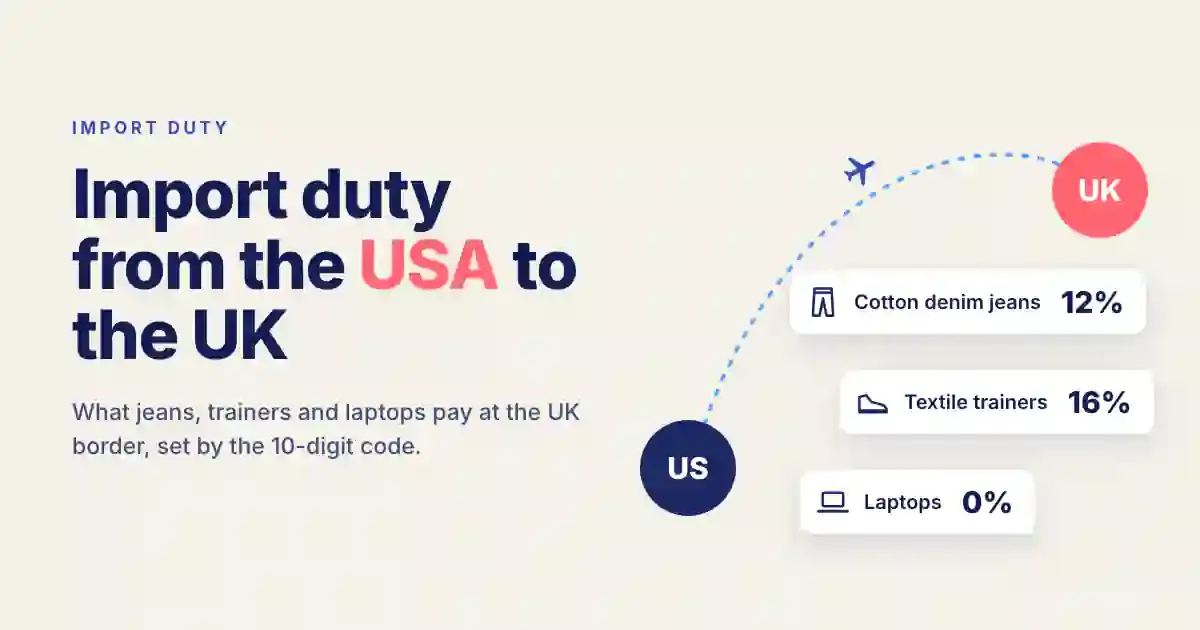
- Rates on common goods range from 0% (skincare, laptops, bourbon) to 12% (denim jeans, peanut butter, some supplements) and 16% (textile trainers)
- The May 2025 Economic Prosperity Deal gave duty-free quotas for US beef and ethanol; we found no other UK tariff cuts for US goods
- Import VAT is 20% on the customs value plus duty and delivery costs, and alcohol also pays Alcohol Duty
- US tariff codes (HTS and Schedule B) only match UK codes for the first six digits
If you buy goods from the United States, you pay UK import duty at the standard rate for the goods' commodity code, and import VAT on top. The UK and US haven't signed a free trade agreement. GOV.UK's page on the UK's trade negotiations with the US still describes one as something the UK "is seeking". So no preferential rates apply to US goods, apart from two quotas created in 2025.
This guide shows how the sums work, gives real UK rates for goods commonly bought from the US, and explains what the 2025 deal did and didn't change.
How import duty from the USA is worked out
- Work out the customs value: the price you paid, plus transport, insurance and handling costs to the UK border. If your US supplier quotes FOB or ex-works, add the freight and insurance yourself. HMRC sets out what to include in valuing imported goods.
- Apply the duty rate for the goods' 10-digit UK commodity code, from the UK Trade Tariff.
- Add import VAT, normally 20%, on the customs value plus duty plus delivery costs to the first UK destination.
Here's an order of textile trainers from a US brand, classified under 6404 11 00 00 at 16%.
| Step | Amount |
|---|---|
| Price paid to the supplier (FOB) | £8,000 |
| Air freight and insurance to the UK | £500 |
| Customs value | £8,500 |
| Customs duty at 16% | £1,360 |
| Delivery from the airport to your warehouse | £150 |
| Value for VAT (£8,500 + £1,360 + £150) | £10,010 |
| Import VAT at 20% | £2,002 |
Freight and delivery figures are illustrative. If you're VAT-registered you can use postponed VAT accounting and reclaim the import VAT on the same VAT return, rather than paying it when the goods arrive.
Our import duty calculator does the same sums once you know the code.
UK duty rates on common goods from the USA
Checked on the UK Trade Tariff on 16 November 2026. None of these codes has a preference for US goods, and none carries any UK retaliatory or additional duty for the US.
| Product | Commodity code | UK duty | Notes |
|---|---|---|---|
| Skincare and moisturisers | 3304 99 00 00 | 0% | |
| Laptops | 8471 30 00 00 | 0% | |
| Bourbon whiskey, bottles of 2 litres or less | 2208 30 11 00 | 0% | Alcohol Duty applies |
| Aftermarket disc brake parts | 8708 30 91 90 | 4% | |
| Maple syrup | 1702 20 90 90 | 8% | VAT 0% |
| Food supplements (vitamin tablets, low sugar and milk fat) | 2106 90 92 85 | 12% | Code depends on composition |
| Men's cotton denim jeans | 6203 42 31 00 | 12% | |
| Peanut butter | 2008 11 10 00 | 12% | Needs a Common Health Entry Document from the US |
| Trainers with rubber or plastic soles and textile uppers | 6404 11 00 00 | 16% | Leather-upper trainers are classified elsewhere |
Supplements are a good example of why the table is only a guide. A vitamin tablet with little sugar or milk fat falls under 2106 90 92 85 at 12%, but supplements with more sugar or dairy content take other codes, and products that count as medicines go to chapter 30.
What the Economic Prosperity Deal changed
The UK and US agreed the Economic Prosperity Deal on 8 May 2025. Its general terms say they aren't a legally binding agreement. On the UK side, they did three things, and all three are now in the Trade Tariff:
- a duty-free quota of 1.4 billion litres a year for US ethanol (order number 059750)
- a duty-free quota of 13,000 tonnes for US beef (order number 059751)
- removal of the 20% in-quota tariff on US beef within the existing high-quality beef quota shared with Canada
To use the quotas you need to show the goods are of US origin, through importer's knowledge or an origin declaration, as the Trade Tariff explains. Outside the quotas, fresh boneless beef pays 12% plus £253 per 100 kg.
The general terms also say the UK intends to cut tariffs on a range of US goods after further negotiation. We found no other UK preferential rates for US goods in the tariff as of 16 November 2026.
The UK has also not applied retaliatory duties on US goods. It consulted on possible countermeasures in spring 2025 but none appear in the tariff. The extra US tariffs you may have read about are charged by the US on UK exports, not by the UK on imports.
Alcohol and other excise goods
Bourbon and other US spirits pay 0% customs duty, but they pay UK Alcohol Duty. Since 1 February 2026, spirits above 22% ABV pay £33.99 per litre of pure alcohol (GOV.UK). A 70cl bottle at 40% contains 0.28 litres of pure alcohol, so it pays £9.52 in Alcohol Duty, before VAT. Customs duty on excise goods is charged whatever the value of the consignment, so the £135 rules below don't apply.
Goods worth £135 or less
For consignments worth £135 or less sold to customers in Great Britain, UK VAT is charged by the seller or online marketplace at the point of sale, and no customs duty is currently charged on non-excise goods.
That duty relief is ending. The government's July 2026 consultation response says it will go by October 2028 at the latest, with full UK rates, quarterly payment by sellers and marketplaces, item-level data and a new fee. US sellers shipping direct to UK customers will need a correct UK commodity code for every item. Our analysis of the low-value import reform covers what that means for classification.
Why a US supplier's code isn't enough
US suppliers usually quote an HTS code, the code used for imports into the US, or a Schedule B number, used on US export declarations. Both share the first six digits with the UK code, because those come from the international Harmonized System. The last four digits are set separately in each country, and so are the rates.
A cotton T-shirt shows the gap: under the US tariff, 6109.10.00 carries 16.5% duty and splits men's, boys', women's and girls' garments at 10 digits. The UK code 6109 10 00 10 carries 12% and doesn't split them that way. We explain how the two systems relate in our UK guide to HTS codes.
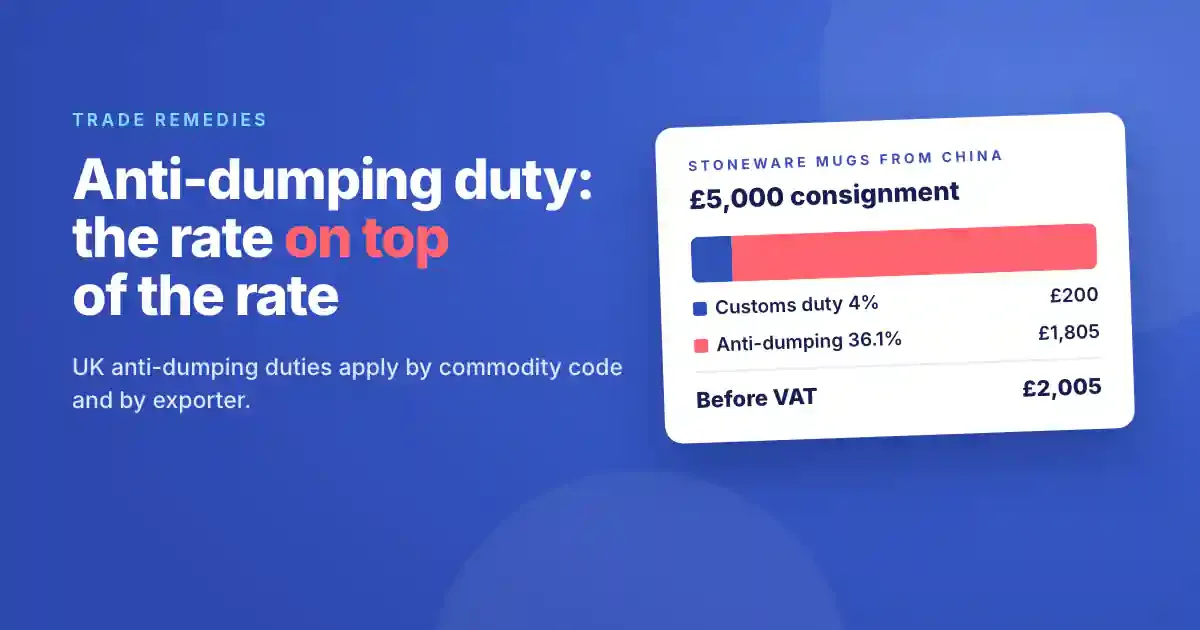
The same porcelain mug shows how origin matters as much as the code. Under 6911 10 00 90, a porcelain mug from the US pays 12%, the same mug from Japan can pay 0% under the UK–Japan agreement, and from China it pays 12% plus anti-dumping duty of up to 36.1%. See our guides to import duty from Japan and import duty from China.
Getting the UK code right
In our audits of new customers, around 2 in 5 tariff codes turn out to be wrong. Codes copied from a US supplier are a common cause.
- For a one-off product, TTExplore suggests up to three 10-digit UK codes with its reasoning, from £2 a code.
- For a range you import regularly, TTVerified gives you codes verified by a customs specialist, with duty rates, anti-dumping and CBAM flags and an audit trail. The 14-day free trial includes 10 classifications, no card needed.
To check a code yourself, follow our guide on how to check a UK commodity code.
FAQ

Elizabeth Davies
Elizabeth has more than 15 years’ experience in customs classification, advising UK retailers, manufacturers and food producers on getting commodity codes right and keeping them right. A regular speaker at Food and Drink Federation (FDF) webinars, she leads the team behind TariffTel’s expert-verified classification methodology.
Connect with Elizabeth on LinkedIn