A stoneware mug from China pays 4% customs duty. With anti-dumping duty on top, an importer without a named exporter rate pays 40.1% of the mug's value. UK anti-dumping duties apply to specific goods from specific countries, and the commodity code is what decides whether they apply to you.
Key takeaways
- Anti-dumping and countervailing duties are charged on top of normal customs duty, for specific goods from specific countries
- They apply by commodity code and origin, and the rate depends on the exporter; without a valid invoice declaration you pay the highest (residual) rate
- Consumer goods with UK measures in force include ceramic tableware, ceramic tiles, ironing boards, bicycles, folding e-bikes, aluminium foil rolls and glass bottles and jars from China
- HMRC can recover underpaid duty for 3 years after import, and up to 20 years in some cases, with interest and penalties of up to £2,500 per error
- Overpaid anti-dumping duty, for example the residual rate paid when a named exporter rate applied, can be reclaimed within 3 years
Anti-dumping duty is the line on an import bill that most businesses never see coming. It doesn't apply to a sector or a type of product in general. It applies to goods under particular commodity codes, from particular countries, made by particular exporters. Get any of those three wrong and you either pay far more than you need to or far less than you owe.
This guide covers what UK anti-dumping and countervailing duties are, the measures in force that affect consumer, retail, food and homeware goods, how exporter-specific rates work, and how to check your own products.
What is anti-dumping duty?
Anti-dumping duty is an extra duty on goods sold into the UK below their normal value in the exporting country, where those imports harm UK producers. Countervailing duty (also called anti-subsidy duty) does the same job for goods that benefit from unfair subsidies abroad. Together they are known as trade remedies.
In the UK, the Trade Remedies Authority (TRA) investigates and recommends measures, the Secretary of State decides whether to apply them, and HMRC collects the duty at import. The legal basis is the Taxation (Cross-border Trade) Act 2018. According to the TRA's annual report, the UK had 46 trade remedy measures in place at 31 March 2026, covering £20.6 billion of imports.
Trade remedies are charged on top of normal customs duty. The commodity code sets the customs duty rate, and it also decides whether a trade remedy applies at all.
UK anti-dumping measures on consumer and retail goods
These are the measures in force on 16 November 2026 that are most likely to affect retailers, homeware and food importers, and e-commerce sellers. The residual rate is what you pay if the exporter isn't named in the notice, or if you can't prove that it is.
| Product | Origin | Type | Commodity codes covered | Residual rate | Runs to |
|---|---|---|---|---|---|
| Ceramic tableware and kitchenware | China | Anti-dumping | 6911 10 00 90, 6912 00 21 11, 6912 00 21 91, 6912 00 23 10, 6912 00 25 10, 6912 00 29 10 | 36.1% | 16 July 2029 |
| Ceramic tiles | China | Anti-dumping | 6907 21 00 00, 6907 22 00 00, 6907 23 00 00, 6907 30 00 00, 6907 40 00 00 | 69.7% | 24 November 2027 |
| Ironing boards | China | Anti-dumping | 3924 90 00 10, 4421 99 99 10, 7323 93 00 10, 7323 99 00 10, 8516 79 70 10, 8516 90 00 51 | 42.3% | 3 October 2029 |
| Ironing boards | Turkey | Countervailing | 7323 93 00 10, 7323 99 00 10, 8516 79 70 10, 8516 90 00 51 | 3.31% | 7 September 2028 |
| Bicycles | China (and bicycles consigned from Cambodia, Indonesia, Malaysia, Pakistan, the Philippines, Sri Lanka and Tunisia) | Anti-dumping | 8712 00 30 10, 8712 00 30 20, 8712 00 30 90, 8712 00 70 91, 8712 00 70 92, 8712 00 70 99, and certain parts in 8714 | 48.5% | 30 August 2029 |
| Folding electric bicycles | China | Anti-dumping and countervailing | 8711 60 10 00, 8711 60 90 10 | 62.1% plus 17.2% | 18 January 2029 |
| Aluminium foil in rolls up to 10 kg | China | Anti-dumping | 7607 11 11 11, 7607 11 11 19, 7607 19 10 11, 7607 19 10 19 | 35.6% | 6 June 2029 |
| Glass bottles, jars and pots under 2.5 litres | China | Provisional anti-dumping | 15 codes in 7010 90 | 52.97% | Up to 6 months from 9 September 2026 |
| Cast iron ground and access covers | China | Anti-dumping | 7325 10 00 31, 7325 99 10 60 | 38.1% | 31 January 2028 |
| Rainbow trout | Turkey | Countervailing | 6 codes in 0301 to 0305 | 9.5% | Continues during an expiry review |
| Aluminium extrusions | China | Anti-dumping | 29 codes in 7604, 7608 and 7610 90 90 10 | 35.1% | 16 December 2027 |
| Bus and lorry tyres | China | Anti-dumping and countervailing | 4011 20 90 00, 4012 12 00 10 | £45.71 plus £64.41 per tyre | October and November 2028 |
| Forged or multi-piece aluminium road wheels | China | Anti-dumping | 4 codes in 8708 70 | 22.3% | 25 January 2027 |
Sources: GOV.UK trade remedies notices and the UK Trade Tariff, checked on 16 November 2026. Non-folding e-bikes are exempt: they are declared with additional code 8100 at 0%.
There are also anti-dumping and countervailing duties on a wide range of steel from China and other countries, including hot-rolled, coated and tin mill products, wire rod, rebar, welded gas pipe and steel ropes. Separately, since 1 July 2026 a new steel trade measure has replaced the old steel safeguard. It isn't a trade remedy, but it charges 50% on in-scope steel imported above quota, and the Trade Tariff now shows that 50% as the duty rate on those codes. Steel anti-dumping duty is charged on top.
How the rate for your goods is decided
Three things decide what you pay.
- The commodity code. A measure lists the codes it covers, and goods under a code outside the list pay no anti-dumping duty, even if they look similar.
- The origin. Measures apply to goods from named countries. Some, like the bicycle measure, also cover goods consigned through other countries, to stop duty being avoided by routing goods elsewhere.
- The exporter. Each notice names overseas producers with their own rate and a four-character additional code, and everyone else pays the residual rate.
To get a named exporter's lower rate, the importer must present a commercial invoice carrying a signed declaration in the wording set out in the notice, and declare it with document code D008. The additional code goes in data element 6/16 of the import declaration. HMRC's guidance on commodity codes and additional codes in CDS explains where each goes. If the invoice declaration is missing, the residual rate applies.
Anti-dumping duty is charged on the net, free-at-the-frontier price of the goods, before other import duties, and it comes in addition to the customs duty. Import VAT is then charged on the total.
A worked example: one mug, two codes, three origins
Our TTVerified demonstration catalogue includes a 350ml ceramic mug, described by the supplier as "MUG 350ML ASST DESIGNS". The description doesn't say what the mug is made of, and that matters. A porcelain mug is classified under 6911 10 00 90 at 12% duty. A stoneware mug is classified under 6912 00 23 10 at 4%. TTVerified asks for the ceramic body before it settles the code.
Then origin comes in. Here is the same porcelain mug from three countries, using UK Trade Tariff rates on 16 November 2026.
| Origin | Customs duty | Anti-dumping duty | What it rests on |
|---|---|---|---|
| China | 12% | 13.1% to 36.1% | The exporter's named rate needs a valid invoice declaration |
| Japan | 0% | None | Proof that the mug meets the UK–Japan rules of origin |
| United States | 12% | None | No trade agreement, so the third-country rate applies |
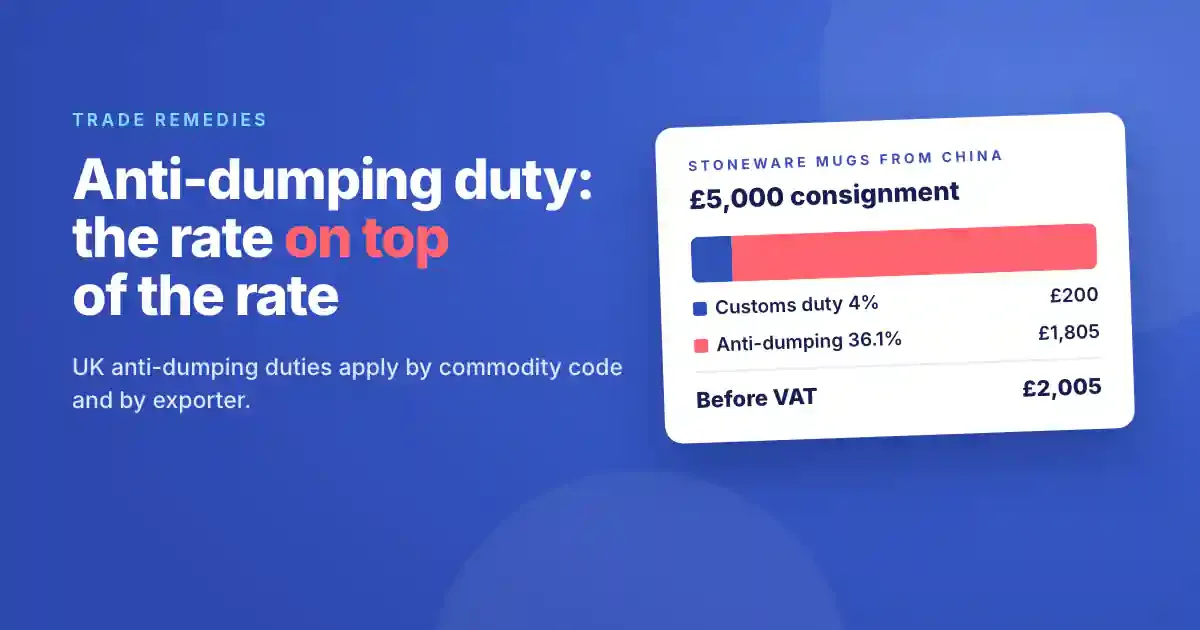
For a stoneware mug from a Chinese exporter without a named rate, a £5,000 consignment would pay £200 customs duty at 4% and £1,805 anti-dumping duty at 36.1%: £2,005 before VAT, or 40.1% of the value of the goods.
Two things follow. A porcelain mug declared as stoneware, or the other way round, changes the customs duty by 8 points. And an importer who doesn't collect the exporter's invoice declaration pays the residual 36.1% even when the factory has a lower named rate. In our demonstration audit, a stoneware mug declared under the porcelain code was overpaying by 8 points: about £14,400 a year on £180,000 of imports.
When origin is the problem: the Morrisons foil case
Anti-dumping duty also turns on origin, and HMRC checks it. In 2025 a tribunal upheld HMRC's challenge to the declared origin of aluminium foil imported by Morrisons. The foil had been declared as Thai, after heating, cutting and boxing in Thailand. The tribunal agreed with HMRC that this processing wasn't enough to make it Thai, so the foil was Chinese and anti-dumping duty applied. The liability was around £4.7 million in duty and VAT. We covered the case in Morrisons, HMRC and a £4.7m ruling.
The UK Trade Tariff has a separate code for foil rolls consigned from Thailand (7607 11 11 11), so the declaration shows where the goods have come from.
What happens if you get it wrong
Underpaid anti-dumping duty is a customs debt, like any other duty, and the importer is liable for it. According to HMRC's guidance on customs debt liability:
- HMRC has 3 years from the date of import to notify you of the debt. For entries on or after 1 January 2021, that period can be extended to up to 20 years.
- HMRC writes first and gives you 30 days to respond, then issues a post-clearance demand note (C18). Interest runs if you pay more than 10 days after the C18.
- HMRC can also charge a civil penalty of up to £2,500 for false information on a declaration, under Customs Notice 301. It normally sends a warning letter first. A written voluntary disclosure made before HMRC starts enquiries means no penalty.
If you have overpaid, for example by paying the residual rate when your exporter had a named rate and you held the invoice declaration, you can reclaim it on form C285 within 3 years. Declarations in CDS can be amended for up to 3 years after acceptance.
What changed in 2026
- The steel safeguard expired on 30 June 2026 and the steel trade measure replaced it on 1 July.
- Anti-dumping and countervailing duties on glass fibre from China ended on 30 January 2026, and anti-dumping duty on cold-rolled steel from China and Russia expired on 5 August 2026.
- Provisional anti-dumping duty on glass bottles and jars from China started on 9 September 2026, and imports of glass containers from Turkey have been registered since March, so a duty could be backdated.
- The TRA opened an interim review of the ceramic tableware measure on 20 July 2026, after Chinese import volumes rose 22% between 2023 and 2025. The rates could change.
The TRA's public case list shows open investigations, including titanium dioxide from China, S-PVC from China, Mexico and South Korea, and a safeguard investigation on PET resin from all origins.
How to check your own products
- Get the 10-digit code right first. Every measure is defined by code, so a check on the wrong code tells you nothing. Our guide to checking a UK commodity code walks through it.
- Look up the code on the UK Trade Tariff and filter by country of origin. Anti-dumping and countervailing duties show under import measures, with each additional code and rate.
- If a measure applies, ask your supplier which producer made the goods, whether it has a named rate, and for the invoice declaration in the notice wording.
- Check where the goods were made as well as where you buy them from. Goods processed or consigned through a third country can still be caught.
- Keep watching. Measures are reviewed, extended and revoked, and new ones start with little notice.
How TariffTel helps
Every code classified in TTVerified is checked for anti-dumping duty, as well as UK CBAM, EUDR and the duty and preferential rates. When a measure applies, it shows the duty range and the supplier codes, so you know what to ask your supplier for before the goods ship. Codes come from expert-built question pathways, like the ceramic body question for the mug, and a customs specialist verifies each one.
You can try it on your own product lines with the 14-day free trial: 10 classifications, no card needed. To estimate duty on a single shipment, use our import duty calculator.
FAQ

Elizabeth Davies
Elizabeth has more than 15 years’ experience in customs classification, advising UK retailers, manufacturers and food producers on getting commodity codes right and keeping them right. A regular speaker at Food and Drink Federation (FDF) webinars, she leads the team behind TariffTel’s expert-verified classification methodology.
Connect with Elizabeth on LinkedIn