



Manufacturing & Engineering Classification

Parts, machines and metals. Classified right.

Parts versus complete machines, steel and aluminium form rules, anti-dumping exposure and CBAM reporting make manufacturing and engineering one of the highest-stakes sectors to classify. TariffTel combines deep tariff expertise with AI-powered automation to deliver accurate, audit-ready HS codes across even the largest bills of materials.
CBAM-Ready Data
Expert-Verified
ISO 27001
Unsplash 1581091226825 A6a2a5aee158 C4221b
HS Code Verified
8483.40.90
Gears & gearing, transmission parts
100% Compliant
Steel content in scope
Over 1.5 million products classified. Trusted by leading UK and European brands.
Asda Logo White Small
Mns Logo White
Parimark Logo White
Portwest Logo White 1
Why It's Hard to Classify

Manufacturing & engineering is high-risk to classify

Engineered goods sit across complex section notes, material-form rules and additional-duty regimes. A single subheading can decide whether a shipment carries standard duty, anti-dumping duty or a CBAM reporting obligation — and the duty amounts involved are rarely small.

Parts vs complete machines
Section XVI / XVII & GRI 2(a)

A component can be classified with its machine, under a dedicated parts heading, or under its own material. An incomplete or unassembled article with the essential character of the finished machine is classified as the machine under GRI 2(a).

Material & form sensitivity
Chapters 72–76

Steel and aluminium are classified by form, alloy, dimension and processing. Carbon content, coating, thickness or a single finishing step can move a product between subheadings — and between duty rates.

Anti-dumping & CBAM exposure
Additional duties & carbon reporting

Anti-dumping, safeguard and CBAM obligations attach to specific codes and origins. Iron, steel and aluminium are squarely in CBAM scope. The exact code decides the exposure — and the wrong one is expensive.

BOM scale & mixed materials
Thousands of line items

Assemblies, tooling, fasteners, bearings and castings produce enormous bills of materials in mixed materials. Classifying each line correctly — and consistently — is a volume problem and a judgement problem at once.

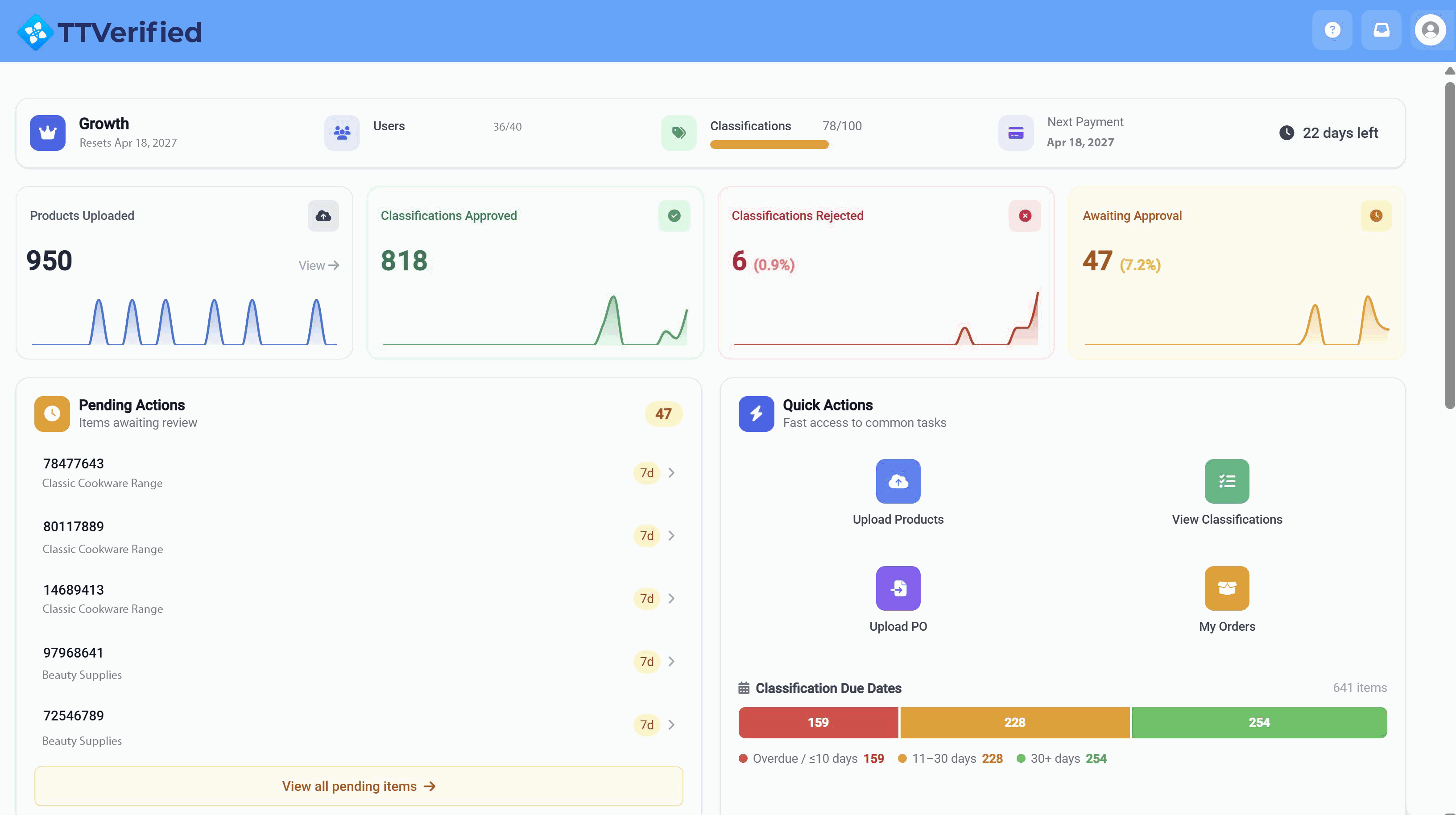
TTVerified dashboard
Setup time
5 minutes

Get accurate HS codes with TTVerified.

TTVerified gives you accurate, expert-backed HS codes in a few clicks.

Enter part or material details, get the right HS code back
Anti-dumping and CBAM exposure flagged at the line level
Full audit trail for HMRC compliance
Get StartedNo credit card required
Parts, Materials & Assemblies

Complexity that generic tools cannot handle

A cast bracket supplied loose for a single machine model. A coil of alloy steel that crosses a thickness threshold. A hydraulic pump that is a complete article in its own right. A part-built assembly shipped knocked-down. Each demands precise data and expert judgement against the section and chapter notes.

Parts follow special rules. Section XVI and XVII notes decide whether a part goes with its machine, under a parts heading, or under its own material
Form changes the code. raw, semi-finished and finished metal in Chapters 72–76 split by alloy, dimension and processing, with small specs shifting subheadings
Incomplete & unassembled goods. GRI 2(a) treats articles with the essential character of the finished product, or shipped knocked-down, as the finished article
Origin & processing matter. preferential duty and a defensible HMRC audit trail depend on accurate origin and the exact commodity code
Unsplash 1504917595217 D4dc5ebe6122 76c567
Classification Challenge
Cast steel bracket supplied loose for one machine model
Resolved: 8466.93.30 (part)
Our Process

How we classify engineered products

A rigorous, three-stage process built on deep tariff expertise and designed to get parts, materials and complete machines right the first time — at any volume.

1

Analysis

We work the Section XVI and XVII legal notes, the relevant chapter notes for Chapters 72–84, established rulings and the General Interpretive Rules — including GRI 2(a) for incomplete and unassembled articles — to determine exactly how each part, material or machine should be classified.

2

Data Collection

We gather every data point that affects the code: function and intended machine, material and alloy composition, form, dimensions and processing, carbon content, coating or finishing, assembly state, origin and the structured details needed for CBAM and anti-dumping checks.

3

Expert Review & Monitoring

Every code is verified by a specialist customs expert, with anti-dumping, safeguard and CBAM exposure flagged. TTVerified then monitors tariff and measure updates continuously so your codes stay correct as duties and trade measures change.
TTVerified dashboard
Product Coverage

Every engineered product, classified

From raw metals and semi-finished stock to complete machinery and the smallest fasteners. TariffTel's experts handle the full spectrum of manufacturing and engineering classifications.


Unsplash 1581091226825 A6a2a5aee158 E0c9b5
Machinery & Equipment
Complete machines, mechanical appliances, pumps, compressors, engines and industrial plant (Chapters 84–85)
Unsplash 1565043666747 69f6646db940 2b273e
Parts & Accessories
Bearings, gears, castings, brackets, tooling and machine-specific components under Section XVI and XVII rules
Unsplash 1504917595217 D4dc5ebe6122 76c567
Steel, Iron & Aluminium
Ingots, flat-rolled coil, bars, wire, tube and sections classified by form, alloy and dimension (Chapters 72–76)
Unsplash 1565514020179 026b92b84bb6 1dabff
Fasteners & Fixings
Bolts, screws, nuts, rivets and springs — categories with well-known anti-dumping exposure by origin
Unsplash 1565043666747 69f6646db940 8744c5
Castings, Forgings & Tooling
Rough and machined castings, forgings, dies, moulds, jigs and interchangeable tools
Unsplash 1581091226825 A6a2a5aee158 Ad343a
Assemblies & Mixed-Material Goods
Sub-assemblies, knocked-down units and composite engineered products combining metal, plastic and rubber
CBAM Readiness

Classification is the foundation of CBAM reporting

The Carbon Border Adjustment Mechanism covers iron and steel, aluminium, cement, fertilisers, hydrogen and electricity — including many downstream iron, steel and aluminium articles. Whether a product is in scope is decided by its CN/HS code, so the classification itself is the trigger for any CBAM obligation.

The structured product and material data TTVerified captures during classification — alloy, form, material content and origin — feeds directly into CBAM reporting, so you are not rebuilding the same evidence twice. For large estates, TTExplore and Managed Services extend the same data discipline across your full catalogue.


In-scope flaggingiron, steel and aluminium goods identified by code as you classify
Material data captured oncealloy, form and content recorded for both the code and CBAM reporting
Audit-ready evidenceevery classification logged with reasoning, reviewer and origin for HMRC and CBAM
Unsplash 1565043666747 69f6646db940 Fe532d
CBAM Status
7208.39.00
In scope — flat-rolled steel
Unsplash 1565514020179 026b92b84bb6 08bd8a
Expert-Verified
Every code reviewed
Why TariffTel for Manufacturing & Engineering

Built for the complexity of engineered goods

When the duty amounts are large and anti-dumping or CBAM is in play, accuracy is not optional. TariffTel understands manufacturing and engineering classification at a level generic tools simply do not reach.

Expert-verified accuracy
Every HS code is backed by a specialist customs expert. AI automates the research and the volume; humans make the section-note and GRI judgement calls.
Full audit trail for HMRC
Every classification decision is logged with reasoning, evidence, expert reviewer and timestamp — a defensible record when duty amounts and additional measures are on the line.
Anti-dumping & CBAM aware
Codes are checked against anti-dumping, safeguard and CBAM measures by code and origin, so exposure is surfaced before it reaches the border or your reporting.
Built for BOM scale
TTVerified, TTExplore and Managed Services classify thousands of line items consistently, so large bills of materials and full product catalogues stay accurate and current.
FAQ

Manufacturing & Engineering Classification Questions

Common questions from manufacturers, engineers and importers about tariff classification, anti-dumping duty and CBAM.

Talk to a Specialist
Machine parts are classified using the Section XVI and Section XVII legal notes. A part may be classified with the machine it belongs to, under a specific heading for that kind of part, or under its own material heading, depending on whether it is suitable for use solely or principally with a particular machine and whether it is excluded by the section notes. Parts that are themselves goods covered by a specific heading (such as pumps, taps, bearings or gaskets) are classified in that heading regardless of the machine. Under GRI 2(a), an incomplete or unassembled article that has the essential character of the finished article is classified as the finished article.
Steel, iron and aluminium products in Chapters 72 to 76 are classified by form, alloy composition, dimension and degree of processing. Whether a product is an ingot, a flat-rolled coil, a bar, a wire, a tube or a finished article changes the heading, and details such as carbon content, alloy elements, thickness, width and whether the surface is clad, coated or further worked all affect the code. Small specification differences can move a product between subheadings with very different duty rates, anti-dumping exposure and CBAM reporting obligations.
The EU Carbon Border Adjustment Mechanism (CBAM) covers iron and steel, aluminium, cement, fertilisers, hydrogen and electricity, including many downstream iron, steel and aluminium articles. Whether a specific product is in scope is determined by its CN/HS code, so an accurate classification is the starting point for any CBAM obligation. If your engineered product is built from in-scope iron, steel or aluminium materials, you may need to report embedded emissions. TariffTel captures structured product and material data during classification that directly supports CBAM reporting.
Yes. Anti-dumping and safeguard measures apply to specific commodity codes for products such as certain steel, aluminium, fasteners and engineered goods, often originating from particular countries. Using the wrong code can either expose you to unexpected additional duties on entry or, worse, leave you under-declaring duty that HMRC can reclaim with penalties going back four years. Because these measures are tied to the exact code and origin, a defensible, expert-verified classification is essential to manage the risk.
Complex assemblies and large bills of materials are handled component by component, applying the Section XVI and XVII notes and the General Interpretive Rules to decide whether each item is classified as part of the finished machine, as a distinct article, or under its own material heading. TariffTel combines AI-powered automation to process volume with specialist expert review on the judgement calls, delivering accurate, consistent codes across thousands of line items with a full audit trail for HMRC.

Stop guessing your manufacturing tariff codes.

Get accurate, expert-verified HS codes for parts, machinery and metals — with anti-dumping and CBAM exposure surfaced before it costs you. Built for the largest bills of materials.

PricingExplore our products