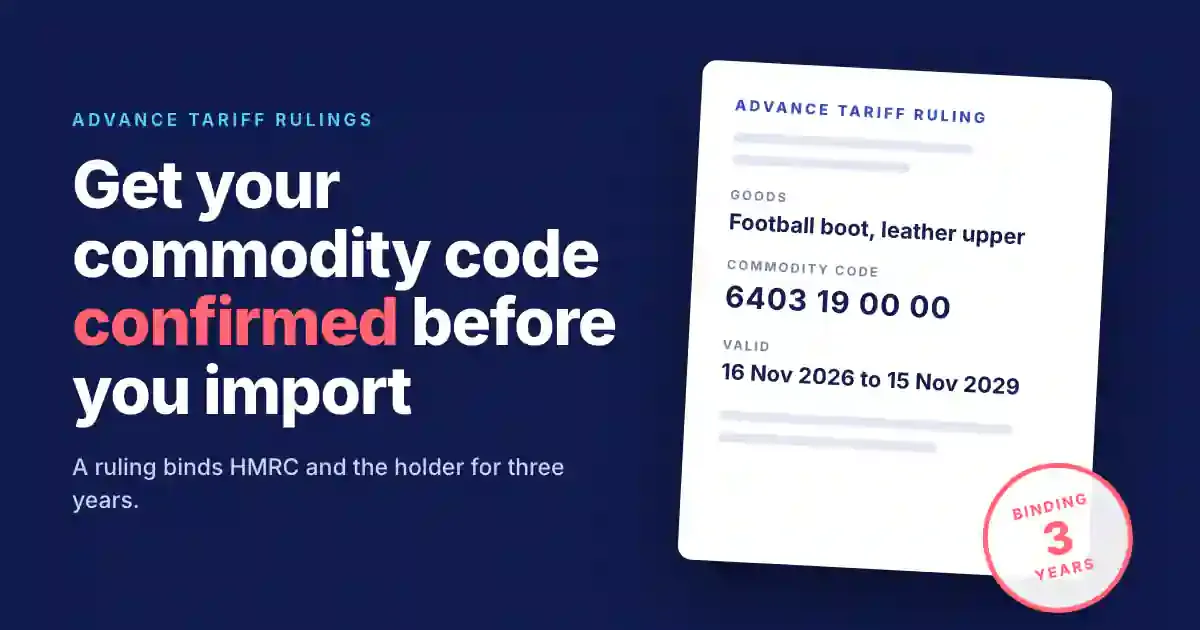
A studded football boot with a leather upper pays 8% customs duty into Great Britain at the standard third-country rate. Make the upper mostly knitted textile and the same boot pays 16%. When a product sits that close to a line, an Advance Tariff Ruling lets you ask HMRC to decide the code before you import, and then hold HMRC to it for three years.
Key takeaways
- An Advance Tariff Ruling (ATR) is a written HMRC decision on the commodity code for one product. It binds both HMRC and the holder for three years from the date of the ruling
- You need an EORI number starting GB and must apply before the goods are declared; HMRC won't rule on goods already cleared
- HMRC has 30 days to accept an application and 120 days from acceptance to issue the ruling, with a possible 30-day extension
- A ruling can end early: when the tariff or the law changes, or when HMRC revokes it, for example after a WCO decision, a court judgment or a change in the product
- Northern Ireland uses EU Binding Tariff Information, not ATRs. HMRC issues BTIs to traders with an XI EORI number
- Rulings are worth it for high-volume lines, borderline headings and codes where the duty gap or an anti-dumping measure makes a wrong code expensive
Most commodity codes are chosen by the importer and only questioned if HMRC audits them. For a product that could reasonably sit under two codes with different duty rates, that risk runs on every shipment until someone checks. An Advance Tariff Ruling settles the question first: you describe the product, HMRC decides the code, and the decision binds both sides.
What is an Advance Tariff Ruling?
An Advance Tariff Ruling (ATR) is HMRC's written decision on the commodity code for a specific product imported into or exported from Great Britain. It is legally binding on HMRC and on the holder for three years from the date of the ruling, and the holder must use it on every declaration for those goods.
The legal basis is section 24 of the Taxation (Cross-border Trade) Act 2018. The detailed rules are in an HMRC public notice made under that section, published with HMRC's notices under the Act.
A ruling gives you:
- the commodity code for your goods and a unique ruling reference
- the start date of its validity
- the name and address of the holder, the only person entitled to use it
- a description of the goods detailed enough to identify them at the border
- HMRC's legal justification, usually citing the General Interpretative Rules and the notes it relied on
Rulings are not transferable, so you can't rely on one held by your supplier or customs agent. An ATR also covers classification only. HMRC issues separate Advance Origin Rulings and Advance Valuation Rulings.
How long is an Advance Tariff Ruling valid?
An ATR is valid for three years from the date of the ruling. A ruling HMRC published with a start date of 16 November 2026, for example, expires on 15 November 2029. It can end sooner if the law or the tariff changes, or if HMRC revokes it.
Under HMRC's public notice, a ruling stops being valid early when a new regulation or agreement means it no longer conforms to the law, or when the wording of the subheading or commodity code changes in a way that alters the classification.
HMRC can revoke a ruling for reasons including:
- a change in the product's composition
- a change to the Harmonised System Explanatory Notes
- a UK court judgment or a World Customs Organization classification decision that affects the interpretation
- the holder failing to tell HMRC about a change that affects the ruling
Neither applies retrospectively. After a revocation, you can ask HMRC in writing within 30 days to keep using the ruling for up to six months for binding contracts made before it was revoked. A ruling can't be amended, so if the product changes you apply again. A ruling obtained with incorrect or incomplete information can be annulled, which treats it as never having existed.
Who can apply for an Advance Tariff Ruling?
Anyone with an EORI number starting GB who intends to import goods into, or export goods from, Great Britain. You must apply before the goods are declared, because HMRC won't rule on goods that have already gone through customs.
HMRC will refuse an application if you already hold or have applied for a ruling on the same goods (except a renewal), if it isn't linked to an intended import or export, if a declaration for the goods has already been accepted, or if you can't supply enough information or evidence. An agent can apply for you with proof that they are authorised to act.
Advance Tariff Rulings and Binding Tariff Information: what's the difference?
Binding Tariff Information (BTI) is the EU's version of the same decision. Great Britain has used Advance Tariff Rulings since the end of the Brexit transition period, while Northern Ireland, which follows EU customs rules, still uses BTI.
| Advance Tariff Ruling | Binding Tariff Information | |
|---|---|---|
| Where it applies | Great Britain | EU member states and Northern Ireland |
| Who issues it | HMRC | HMRC for traders established in Northern Ireland; otherwise an EU member state's customs authority |
| EORI needed | Starting GB | Starting XI (for HMRC-issued BTIs) |
| How to apply | HMRC online service | EU Customs Trader Portal, after enrolling with HMRC |
| Validity | 3 years | 3 years |
| HMRC response | 30 to 120 days | Aims to reply within 120 days |
| Legal basis | Taxation (Cross-border Trade) Act 2018, s.24 | Union Customs Code, Articles 33 and 34 |
| Published rulings | Search for Advance Tariff Rulings | EU EBTI database |
If you are not established in Northern Ireland and want a ruling for goods moving into the EU, HMRC's guidance says to apply to that EU country's customs authority.
When is an Advance Tariff Ruling worth applying for?
A ruling is worth the time when a wrong code would be expensive and the right code is open to argument. If the tariff text makes the code plain, or the product will change before the ruling arrives, a well-documented classification of your own usually does the job.
A ruling tends to pay off for:
- high-volume lines, where a few points of duty add up over a year
- borderline headings, where the tariff turns on a judgement such as which material dominates or whether a food is a preparation
- codes either side of a large duty gap, or where one code carries an anti-dumping duty, quota or licence requirement and the other doesn't
- products HMRC has already queried
It is usually not worth it for seasonal or one-off lines that will sell through before the ruling arrives, or products whose specification changes often. And only apply if you can live with an answer that goes against you: once you hold a ruling, you must use it, even if the duty is higher than you hoped.
Remember the limits. Each application covers one product (variants count as one only if their differences don't affect the classification), HMRC can take up to 120 days after accepting the application, and the ruling covers only the goods it describes.
Worked example: a football boot with a leather and textile upper
A football boot with studs counts as "sports footwear" under Subheading Note 1 to Chapter 64. With a rubber or plastics sole, its code then depends on the material of the upper, and the duty doubles between the two candidates.
| Commodity code | Tariff description | Third-country duty (GB) |
|---|---|---|
| 6403 19 00 00 | Footwear with outer soles of rubber, plastics, leather or composition leather and uppers of leather: sports footwear: other | 8% |
| 6404 11 00 00 | Footwear with outer soles of rubber, plastics, leather or composition leather and uppers of textile materials: with outer soles of rubber or plastics: sports footwear; tennis shoes, basketball shoes, gym shoes, training shoes and the like | 16% |
Source: UK Trade Tariff API, checked 16 November 2026. Preferential rates may apply if the rules of origin are met.
Note 4(a) to Chapter 64 says the material of the upper is the one with the greatest external surface area, ignoring accessories and reinforcements such as ankle patches, edging and eyelet stays. An additional chapter note in the UK tariff adds that the areas covered by those reinforcements still count. Note 3 adds a third route: textile with an outer layer of plastics visible to the naked eye counts as plastics, which would put the boot in 6402 19 00 00, also at 16%.
The rule is clear; the facts are harder. For a boot that is roughly half leather and half knitted textile, the answer depends on measuring surface areas, deciding which pieces are reinforcements and checking whether any synthetic panel is coated textile. On 10,000 pairs a year at a customs value of £30 a pair, the gap between 8% and 16% is £24,000 a year. That is a line worth a ruling, with a sample and a measured breakdown of the upper.
How to apply for an Advance Tariff Ruling
You apply online through HMRC's Advance Tariff Ruling service, signing in with the details you used to register for your EORI number. Each type of goods needs its own application.
- Check the published rulings for the same or similar goods, because the application asks whether you know of any.
- Gather specification sheets, a materials or ingredients breakdown, photographs, brochures or manuals, and a sample if the code turns on something you can only judge by handling the product.
- Sign in through your business tax account ("get online access to a tax, duty or scheme") or directly through the service.
- Enter the description, the commercial name, the purpose of the import and the code you think applies.
- Mark any attachments you want kept confidential. HMRC publishes rulings without personal or confidential details, but unmarked attachments may be made public.
- If you plan 10 or more applications in one week, email the Tariff Classification Service at tariff.classification@hmrc.gov.uk first.
When the ruling arrives, give the reference and code to whoever completes your import declarations, and quote the reference on each declaration for those goods.
How long does HMRC take to issue a ruling?
HMRC's guidance says it replies in 30 to 120 days. Under the public notice, HMRC has 30 days to accept the application, refuse it or ask for more information, then 120 days from acceptance to issue the ruling.
If HMRC asks for more information and you don't reply within 30 days, the application is treated as withdrawn. If HMRC doesn't respond within 30 days of receiving it, the application is treated as accepted. If HMRC can't rule within 120 days, it must write before the deadline with a revised date, normally no more than 30 days later. For a product that needs a sample or follow-up questions, plan for around five months.
How to prepare an application HMRC will accept
Most delays come from descriptions that don't give HMRC enough to classify. Write as if the reader has never seen the product and must choose between your candidate codes from your words alone.
Include:
- what the product is, what it does and its trade name
- composition by material or ingredient with percentages by weight, and surface areas where they decide the code
- how it is made, such as knitted or woven, cooked or raw
- how it is presented: packaging, retail sale, sets and included accessories
- the code you propose and why, against the General Interpretative Rules (GIRs), the section and chapter notes and any explanatory notes
- any rulings you hold, or know of, for similar goods
Our guide to writing a clear goods description covers the detail that changes codes in food, clothing and homeware. Keep the evidence on file, because HMRC can ask you to prove that the goods you declare match the ruling in every relevant respect.
Searching existing Advance Tariff Rulings
HMRC publishes ATRs on its Search for Advance Tariff Rulings service, searchable by words, commodity code or ruling reference. It listed 6,155 rulings on 16 November 2026.
Each entry shows the description HMRC relied on, the code, the start and expiry dates and the justification, which shows how HMRC reasons about products like yours. But a ruling binds only its holder, and if your product differs in a detail that affects the code, someone else's ruling doesn't settle yours. EU BTIs are published in the European Commission's EBTI database.
Can you challenge an Advance Tariff Ruling?
Yes. You can ask HMRC for a review, appeal to the independent tax tribunal, or do both in turn. The decision notice explains how.
Under the Finance Act 1994, you have 30 days from the date of HMRC's offer of a review to accept it; HMRC's guidance says to email reviews@hmrc.gov.uk. An appeal to the tax tribunal is normally due within 30 days of the decision, or within 30 days of the review's conclusion if you take a review first. Until a ruling is overturned, keep declaring the ruled code. Our guide to the consequences of misclassification explains what declaring a different code can cost.
How TariffTel helps
An ATR application needs a precise description and a reasoned path to the code. TTVerified classifies through expert-built question pathways covering about 180,000 item types, with 99% accuracy and a full audit trail of the answers behind each code. Its AI clarifies poor descriptions and identifies missing detail, such as the surface-area split on an upper, and it flags measures like anti-dumping duty.
You can use that reasoning and audit trail as the basis of the product description and rationale in your application. It helps you prepare the evidence; it can't promise what HMRC will rule. For lines that don't justify a ruling, it gives you a documented code. Try it with the 14-day free trial: 10 classifications, no card needed.
FAQ

Elizabeth Davies
Elizabeth has more than 15 years’ experience in customs classification, advising UK retailers, manufacturers and food producers on getting commodity codes right and keeping them right. A regular speaker at Food and Drink Federation (FDF) webinars, she leads the team behind TariffTel’s expert-verified classification methodology.
Connect with Elizabeth on LinkedIn