The UK has no trade agreement with China, so goods from China pay the full UK Global Tariff rate for their commodity code, plus 20% import VAT on most goods. Some products, including ceramic mugs, bicycles and aluminium foil, also carry anti-dumping duty that can be several times the customs duty. Here's how to work out what you'll pay.
Key takeaways
- Goods from China pay the UK Global Tariff (third-country) rate for their 10-digit commodity code; there is no UK–China trade agreement and China isn't in the Developing Countries Trading Scheme
- Rates range from 0% (LED bulbs, laptops, earbuds, wooden furniture) to 12% or more (clothing, porcelain tableware, bicycles at 14%)
- Anti-dumping duty applies on top for some Chinese goods, such as ceramic tableware (up to 36.1%), bicycles (up to 48.5%) and folding e-bikes
- Import VAT is 20% on the customs value plus duty and delivery costs to the first UK destination, and VAT-registered businesses can account for it on their VAT return
- Customs duty relief for consignments of £135 or less is due to end by October 2028 at the latest
If you're importing from China, the short answer is yes, you pay duty, and the rate depends on the commodity code. Goods from China pay the UK Global Tariff third-country rate for their 10-digit code, because the UK has no trade agreement with China. On top of that you pay import VAT, normally 20%. A small but important set of products also carries anti-dumping duty.
This guide shows how the sums work, gives real rates for products UK businesses commonly buy from China, and covers anti-dumping, the £135 rules and how to get the code right.
How import duty from China is worked out
There are three steps.
- Work out the customs value. For most imports this is the price you paid plus the cost of transport, insurance and handling to the UK border, as HMRC explains in valuing imported goods. If you buy on FOB terms, add the sea or air freight and insurance to the UK.
- Apply the duty rate for the goods' 10-digit commodity code. That rate comes from the UK Trade Tariff, and most UK rates are a percentage of the customs value.
- Add import VAT. VAT is charged on the customs value plus the duty, plus delivery costs to the first destination in the UK. The standard rate is 20%; some goods, such as most food and children's clothing, are zero-rated.
Here's how that works for a £10,000 order of cotton T-shirts from China, classified under 6109 10 00 10 at 12%.
| Step | Amount |
|---|---|
| Price paid to the supplier (FOB) | £10,000 |
| Sea freight and insurance to the UK port | £600 |
| Customs value | £10,600 |
| Customs duty at 12% | £1,272 |
| Haulage from the port to your warehouse | £200 |
| Value for VAT (£10,600 + £1,272 + £200) | £12,072 |
| Import VAT at 20% | £2,414.40 |
Freight and handling figures are illustrative. If you're VAT-registered, you can use postponed VAT accounting to declare and reclaim the import VAT on the same VAT return instead of paying it at the border. You don't need approval, but if an agent or courier makes the declaration you must tell them in writing before they declare.
Our import duty calculator runs the same sums once you have the code and duty rate.
UK duty rates on common goods from China
These rates were checked on the UK Trade Tariff on 16 November 2026. None of these codes has a preference for China, so the third-country rate applies.
| Product | Commodity code | UK duty | Anti-dumping duty from China |
|---|---|---|---|
| LED bulbs | 8539 52 00 00 | 0% | None |
| Wireless earbuds | 8518 30 00 90 | 0% | None |
| Wooden dining and living room furniture | 9403 60 10 00 | 0% | None |
| Soft toys | 9503 00 41 00 | 4% | None |
| Silicone or plastic phone cases | 3926 90 97 90 | 6% | None |
| Stoneware mugs and tableware | 6912 00 23 10 | 4% | Up to 36.1% |
| Porcelain mugs and tableware | 6911 10 00 90 | 12% | Up to 36.1% |
| Cotton T-shirts | 6109 10 00 10 | 12% | None |
| Bicycles (not motorised) | 8712 00 30 90 | 14% | Up to 48.5% |
| Electric bicycles (pedal assist, up to 250W) | 8711 60 10 00 | 6% | Folding models: 62.1% plus 17.2% countervailing duty |
The same product can sit under different codes depending on what it's made of or how it's used. Leather phone cases, for example, aren't classified with silicone ones, and supplements vary by composition. Treat the table as a guide to the range, not a substitute for classifying your own goods.
Anti-dumping duty on Chinese goods
Anti-dumping duty is charged on top of customs duty when the UK has found that certain goods from a country are sold here below their normal value. Most UK measures in force apply to goods from China. Those most likely to affect retailers and e-commerce sellers include:
| Product | Residual anti-dumping rate |
|---|---|
| Ceramic tableware and kitchenware | 36.1% |
| Ceramic tiles | 69.7% |
| Ironing boards | 42.3% |
| Bicycles | 48.5% |
| Folding e-bikes | 62.1% plus 17.2% countervailing duty |
| Aluminium foil in rolls up to 10 kg | 35.6% |
| Glass bottles and jars (provisional, from 9 September 2026) | 52.97% |
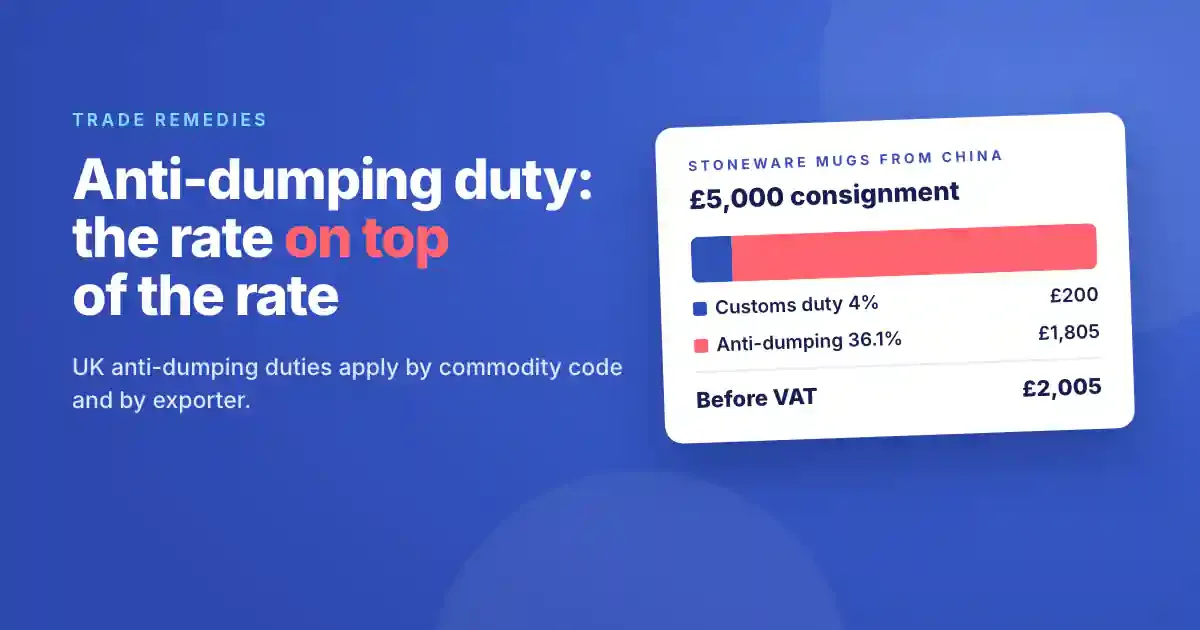
The residual rate is what you pay unless your exporter is named in the measure with a lower rate and you have its signed invoice declaration. Take a £5,000 consignment of stoneware mugs from a Chinese exporter without a named rate: customs duty at 4% is £200, and anti-dumping duty at 36.1% is £1,805. That's £2,005 before VAT, or 40.1% of the value of the goods.
Our guide to UK anti-dumping duties by commodity code lists every consumer-goods measure, the codes it covers and how exporter rates work.
Four Chinese products, four classification questions
These come from TariffTel's worked examples, where the code depends on a detail a supplier description often leaves out.
| Product | What decides the code | Code and UK duty |
|---|---|---|
| 350ml ceramic mug | Whether the body is stoneware or porcelain | 6912 00 23 10 at 4%, or 6911 10 00 90 at 12%, with anti-dumping duty either way |
| Slim RFID card holder | The material of the outer surface: steel takes it out of cases (4202) and into articles of steel | 7326 90 98 90 at 2%, and in UK CBAM scope from 2027 |
| Five-piece bamboo utensil set | The material of the working edge, not the handle | 4419 19 00 00 at 0% |
| True wireless earbuds with charging case | Their main function is playing sound in the ear, so they aren't classified as communication apparatus | 8518 30 00 90 at 0% |
The card holder shows a newer risk. From 1 January 2027, UK CBAM puts a carbon charge on imports of iron, steel and aluminium goods, and no country is exempt. A Chinese steel product under a CBAM code counts towards the £50,000 threshold even though its customs duty is only 2%. See our UK CBAM goods list for the codes in scope.
Goods worth £135 or less
For consignments worth £135 or less sold to customers in Great Britain, VAT is charged at the point of sale, not at the border. The overseas seller, or the online marketplace if the sale goes through one, accounts for it. Customs duty isn't currently charged on non-excise goods in these consignments (GOV.UK).
That relief is ending. The November 2025 Budget said it would go by March 2029 at the latest, and the government's consultation response on 13 July 2026 brought that forward to October 2028 at the latest. Full UK Global Tariff rates will apply, sellers and marketplaces will pay quarterly and provide item-level data, and a new fee will be added. Goods subject to anti-dumping duty will need standard customs declarations. We looked at what this means for classification in our analysis of the low-value import reform.
Getting the code right
Every number in this guide starts with the commodity code: the duty rate, whether anti-dumping applies, whether a product is in CBAM scope, even whether VAT is 20% or 0%. Supplier codes from China are often 8-digit export codes or Chinese tariff codes, which don't map neatly onto UK 10-digit import codes. In our audits of new customers, around 2 in 5 codes turn out to be wrong.
- For a one-off product, TTExplore suggests up to three 10-digit UK codes with its reasoning, from £2 a code.
- For a range you import regularly, TTVerified gives you codes verified by a customs specialist, with the duty rate, anti-dumping and CBAM flags and an audit trail. The 14-day free trial includes 10 classifications.
If you'd rather check codes yourself, our guide on how to check a UK commodity code walks through the UK Trade Tariff step by step.
FAQ

Elizabeth Davies
Elizabeth has more than 15 years’ experience in customs classification, advising UK retailers, manufacturers and food producers on getting commodity codes right and keeping them right. A regular speaker at Food and Drink Federation (FDF) webinars, she leads the team behind TariffTel’s expert-verified classification methodology.
Connect with Elizabeth on LinkedIn