Most goods from Japan can come into the UK at 0% duty under the UK–Japan Comprehensive Economic Partnership Agreement. The catch is that the preference isn't automatic. The goods have to meet the agreement's rules of origin, and you need the right proof when you declare them. Without it you pay the full UK rate.
Key takeaways
- Goods from Japan can be imported at preferential rates, usually 0%, under the UK–Japan CEPA (in force since 1 January 2021) or the CPTPP (in force between the UK and Japan since 15 December 2024)
- The preference only applies if the goods meet the rules of origin and you claim it with a statement on origin from the exporter or your own importer's knowledge
- Without proof of origin you pay the UK Global Tariff rate, such as 10% on a new car or 12% on porcelain tableware
- For cars, CEPA gives 0% while CPTPP is still 2% in 2026, so the agreement you claim under matters
- Import VAT at 20% applies either way, and excise goods such as whisky also pay Alcohol Duty
Japan is one of the few major sourcing countries where the UK has a trade agreement that takes most customs duty to zero. The UK–Japan Comprehensive Economic Partnership Agreement (CEPA) has been in force since 1 January 2021, and since 15 December 2024 the UK and Japan have also traded under the CPTPP, the Comprehensive and Progressive Agreement for Trans-Pacific Partnership.
Both agreements give preferential rates, but neither applies on its own. You claim the preference on your import declaration, the goods must meet the rules of origin, and you must be able to prove it. The Department for Business and Trade's FTA monitoring report found that 73.9% of eligible UK imports from Japan used preferential rates in 2023 to 2024, saving an estimated £311 million in duty. The other quarter paid duty they may not have needed to.
UK duty on common goods from Japan
Checked on the UK Trade Tariff on 16 November 2026.
| Product | Commodity code | UK rate without a preference | UK–Japan CEPA | CPTPP |
|---|---|---|---|---|
| New petrol car, 1,500 to 3,000 cc | 8703 23 19 00 | 10% | 0% | 2% |
| New self-charging hybrid car, over 1,000 cc | 8703 40 10 90 | 10% | 0% | 2% |
| Porcelain mugs and tableware | 6911 10 00 90 | 12% | 0% | 0% |
| Kitchen knives with fixed blades | 8211 92 00 00 | 8% | 0% | 0% |
| Soy sauce | 2103 10 00 00 | 6% (suspended to 0% for all origins until 31 December 2028) | 0% | 0% |
| Green tea, packs of 3 kg or less | 0902 10 00 00 | 2% | 0% | 0% |
| Motorcycle parts and accessories | 8714 10 90 90 | 2% | 0% | 0% |
| Cosmetics and skincare | 3304 99 00 00 | 0% | 0% | 0% |
| Digital cameras | 8525 89 00 00 | 0% | 0% | 0% |
| Japanese whisky, bottles of 2 litres or less | 2208 30 82 00 | 0% | 0% | 0% |
Where the normal rate is already 0%, there's nothing to claim. Soy sauce is a temporary case: its duty has been suspended to 0% for every origin from 21 June 2026 to 31 December 2028, so no preference claim is needed while the suspension lasts.
What the preference is worth
A new Japanese petrol car with a customs value of £30,000 shows the difference.
| How it's declared | Duty |
|---|---|
| No preference claimed, or origin can't be proved | £3,000 (10%) |
| Claimed under CPTPP | £600 (2%) |
| Claimed under the UK–Japan CEPA | £0 |
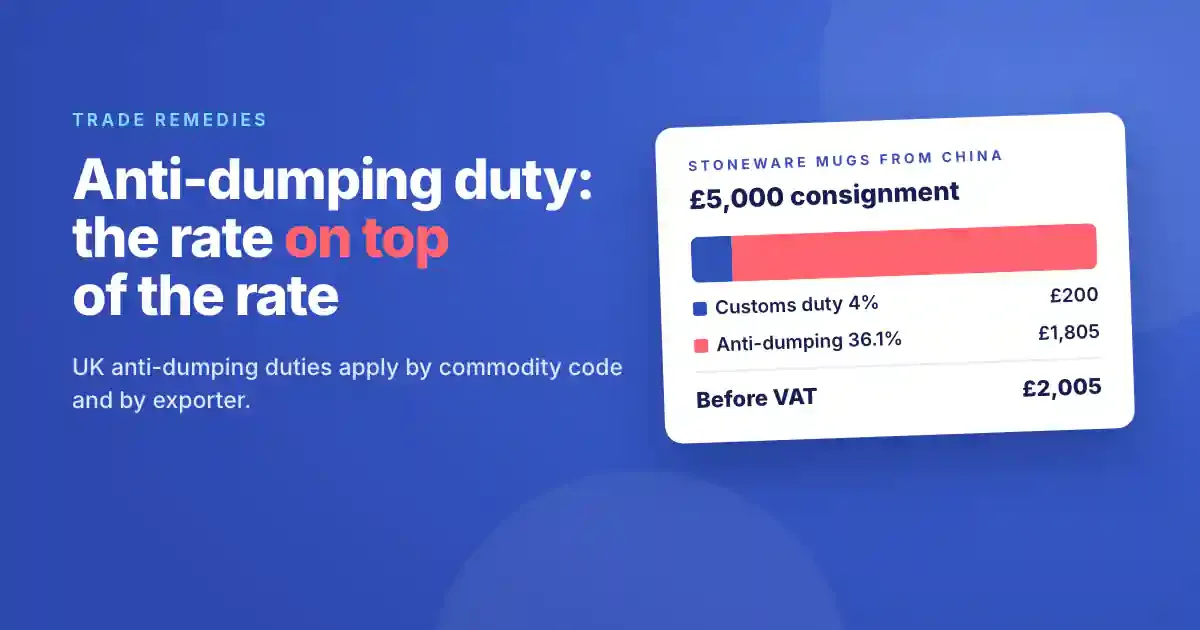
The same pattern applies to porcelain. A porcelain mug under 6911 10 00 90 pays 12% from the US, 0% from Japan with valid proof of origin, and from China 12% plus anti-dumping duty of up to 36.1%. Origin decides as much as the code does. Our guides to import duty from China and UK anti-dumping duties cover the China side.
How do you claim 0% duty on goods from Japan?
You can claim 0% on goods that meet the UK–Japan CEPA rules of origin, provided you claim the preference on the declaration and hold proof of origin. It takes five steps.
- Classify the goods. The rules of origin are set by commodity code, so you need the right code before you can tell which rule applies.
- Check the product-specific rule of origin. Goods must be wholly obtained in Japan, or processed enough in Japan to meet the rule for their code. For cars under heading 8703, for example, the CEPA rule from 1 January 2026 allows no more than 45% non-originating materials by ex-works price, or requires at least 60% regional value content. The UK Trade Tariff shows the rule for each code.
- Choose your proof of origin. Under CEPA you can rely on a statement on origin made out by the Japanese exporter on the invoice or another commercial document, or on your own importer's knowledge, backed by evidence from the exporter such as the production process and the value of non-originating materials. HMRC's guidance on importer's knowledge lists what to ask for. Consignments under £1,000 don't need a statement on origin.
- Claim on the declaration. Your declaration needs the preference code and the document codes for your proof, which your customs agent will add.
- Keep the records. HMRC asks you to keep the declaration, proof of origin and supporting documents for at least 4 years.
Under CPTPP the proof is different: a certification of origin from the exporter, producer or importer. It has no set format but must contain a minimum data set, and it can cover one shipment or identical goods over 12 months. You can choose whichever agreement suits the goods, and for cars that means CEPA.
If you can't prove origin
You pay the normal UK Global Tariff rate. If you later get valid proof of origin, you may be able to reclaim the duty within 3 years.
Claiming a preference you can't support is the more expensive mistake. If HMRC checks the claim and the goods don't meet the rules of origin, it can recover the duty for 3 years after import, or longer in some cases, with interest, and may charge a penalty. Origin is a question HMRC tests closely, as the Morrisons aluminium foil case showed in 2025.
Import VAT and excise
The preference only covers customs duty. Import VAT is charged at 20% on most goods (0% on most food, including green tea and soy sauce), on the customs value plus duty and delivery costs to the first UK destination. VAT-registered businesses can use postponed VAT accounting.
Japanese whisky pays no customs duty, but it pays UK Alcohol Duty: £33.99 per litre of pure alcohol for spirits above 22% ABV since 1 February 2026, which is £9.52 on a 70cl bottle at 40%.
Getting the code and origin right
A preference claim depends on two things HMRC can check after the event: the commodity code and the origin. In our audits of new customers, around 2 in 5 tariff codes turn out to be wrong, and a wrong code can mean you're applying the wrong rule of origin.
TTVerified shows the duty and preferential rates for every code it classifies, so you can see where a preference is available. It shows that the preference applies if the rule of origin is met; whether a particular product meets the rule depends on how and where it was made, and that evidence comes from your supplier. Codes come from expert-built question pathways and are verified by a customs specialist, with an audit trail behind each one. The 14-day free trial includes 10 classifications, no card needed.
For a single product, TTExplore suggests up to three 10-digit UK codes with its reasoning, from £2 a code. To estimate duty and VAT on a shipment, use our import duty calculator.
FAQ

Elizabeth Davies
Elizabeth has more than 15 years’ experience in customs classification, advising UK retailers, manufacturers and food producers on getting commodity codes right and keeping them right. A regular speaker at Food and Drink Federation (FDF) webinars, she leads the team behind TariffTel’s expert-verified classification methodology.
Connect with Elizabeth on LinkedIn