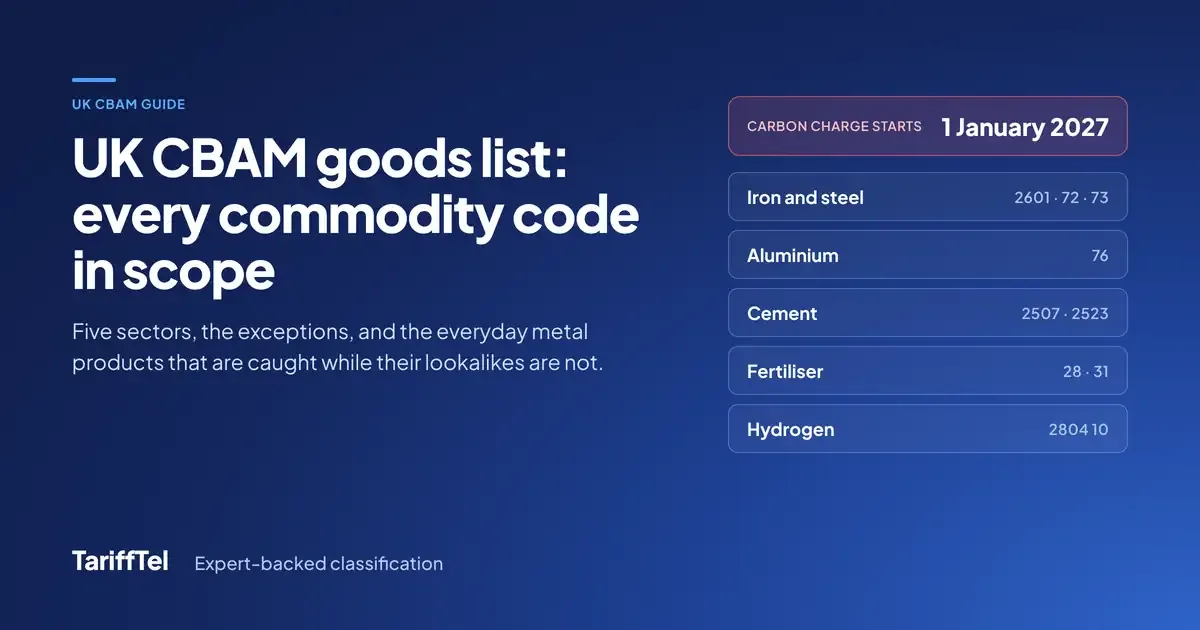
From 1 January 2027, UK CBAM puts a carbon charge on imports of iron and steel, aluminium, cement, fertiliser and hydrogen. Whether a product is caught depends on one thing: its commodity code. This is HMRC's full list, sector by sector, with the exceptions and the lookalikes that sit just outside it.
Key takeaways
- HMRC lists UK CBAM goods by heading or subheading; every code under a listed heading is in scope unless HMRC names it as an exception
- All of chapter 72 (iron and steel) is in scope, apart from most ferro-alloys and ferrous scrap
- Everyday articles are caught: screws and bolts (7318), empty steel or aluminium cans (7310, 7612), aluminium foil (7607) and other articles of steel or aluminium (7326, 7616)
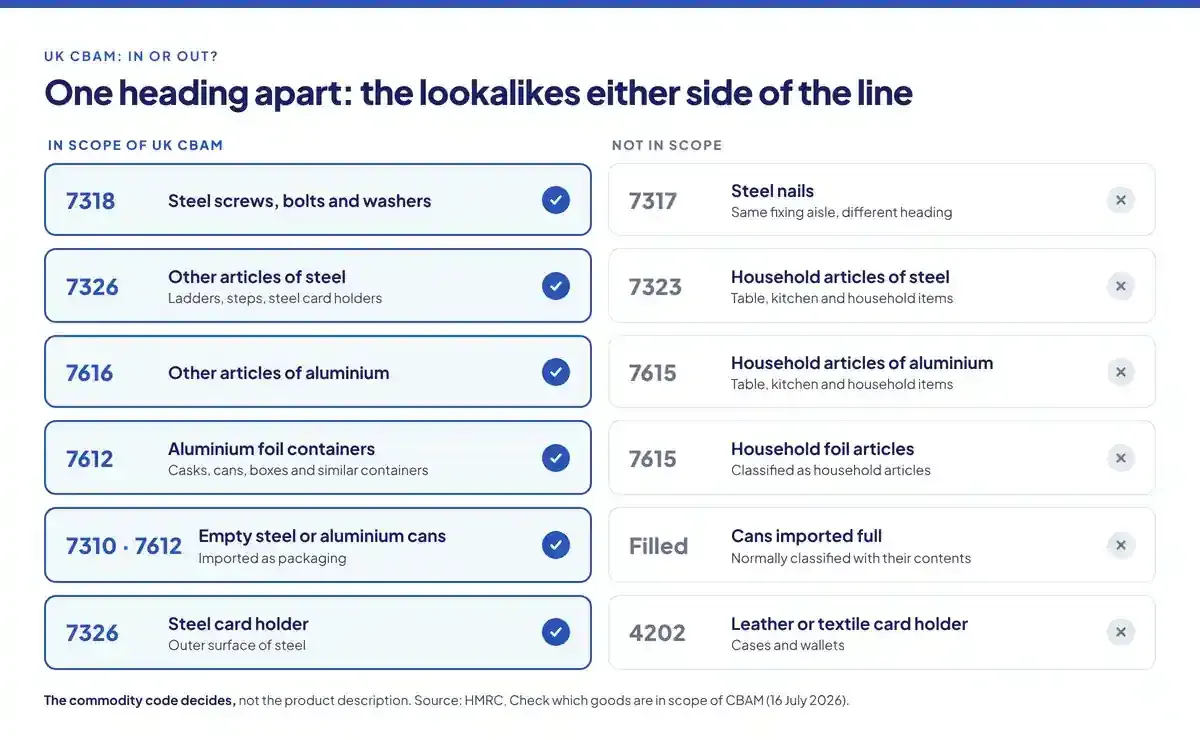
- Household articles of steel (7323) and aluminium (7615) are not on the list, so the line between "household" and "other" decides whether you owe CBAM
- A wrong code can hide a liability or create a reporting burden you don't have
UK CBAM starts on 1 January 2027. If you import goods in five sectors (iron and steel, aluminium, cement, fertiliser and hydrogen), you may owe a carbon charge on them once their value passes £50,000 in a rolling 12 months. We explained the scheme, the threshold and the timetable in UK CBAM starts on 1 January 2027. This guide is the reference that goes with it: the list of commodity codes HMRC says are in scope.
How HMRC defines UK CBAM scope
HMRC publishes one list per sector in its guidance check which goods are in scope of CBAM. The lists were last updated on 16 July 2026. Each entry is a chapter, heading or subheading, and HMRC's rule is simple: if a heading or subheading is listed, every code beneath it is in scope too, unless it appears in the list of exceptions.
That makes the commodity code the trigger. You don't decide whether a product is a "steel product" by looking at it. You decide by classifying it, and then checking whether its code falls under one of the entries below.
UK CBAM goods list: iron and steel
The iron and steel list is the widest. It covers all of chapter 72 and a set of headings in chapter 73 that include finished articles.
| Commodity code | Description |
|---|---|
| 2601 12 | Agglomerated iron ores and concentrates, other than roasted iron pyrites |
| 72 | Iron and steel (the whole chapter, except the items in the exceptions table) |
| 7301 | Sheet piling of iron or steel; welded angles, shapes and sections |
| 7302 | Railway or tramway track construction material of iron or steel |
| 7303 | Tubes, pipes and hollow profiles, of cast iron |
| 7304 | Tubes, pipes and hollow profiles, seamless, of iron or steel |
| 7305 | Other tubes and pipes with an external diameter over 406.4 mm |
| 7306 | Other tubes, pipes and hollow profiles of iron or steel |
| 7307 | Tube or pipe fittings of iron or steel |
| 7308 | Structures and parts of structures of iron or steel |
| 7309 | Reservoirs, tanks, vats and similar containers over 300 litres |
| 7310 | Tanks, casks, drums, cans, boxes and similar containers of 300 litres or less |
| 7311 | Containers for compressed or liquefied gas |
| 7318 | Screws, bolts, nuts, coach screws, screw hooks, rivets, washers and similar articles |
| 7326 | Other articles of iron or steel |
The greenhouse gas covered for iron and steel is carbon dioxide.
UK CBAM goods list: aluminium
| Commodity code | Description |
|---|---|
| 7601 | Unwrought aluminium |
| 7603 | Aluminium powders and flakes |
| 7604 | Aluminium bars, rods and profiles |
| 7605 | Aluminium wire |
| 7606 | Aluminium plates, sheets and strip over 0.2 mm thick |
| 7607 | Aluminium foil up to 0.2 mm thick, whether or not printed or backed |
| 7608 | Aluminium tubes and pipes |
| 7609 | Aluminium tube or pipe fittings |
| 7610 | Aluminium structures and parts of structures |
| 7611 | Aluminium reservoirs, tanks and vats over 300 litres |
| 7612 | Aluminium casks, drums, cans, boxes and similar containers of 300 litres or less |
| 7613 | Aluminium containers for compressed or liquefied gas |
| 7614 | Stranded wire, cables and plaited bands of aluminium, not electrically insulated |
| 7616 | Other articles of aluminium |
The gases covered for aluminium are carbon dioxide and perfluorocarbons.
UK CBAM goods list: cement, fertiliser and hydrogen
| Sector | Commodity code | Description |
|---|---|---|
| Cement | 2507 00 80 | Other kaolinic clays |
| Cement | 2523 10 | Cement clinkers |
| Cement | 2523 21 | White Portland cement |
| Cement | 2523 29 | Other Portland cement |
| Cement | 2523 30 | Aluminous cement |
| Cement | 2523 90 | Other hydraulic cements |
| Fertiliser | 2808 00 | Nitric acid, sulphonitric acids |
| Fertiliser | 2814 | Ammonia, anhydrous or in aqueous solution |
| Fertiliser | 2834 21 | Nitrates of potassium |
| Fertiliser | 3102 | Mineral or chemical fertilisers, nitrogenous |
| Fertiliser | 3105 | Mineral or chemical fertilisers containing two or three of nitrogen, phosphorus and potassium, and other fertilisers |
| Hydrogen | 2804 10 | Hydrogen |
Cement and hydrogen cover carbon dioxide. Nitric acid, potassium nitrate and the fertilisers in 3102 and 3105 also cover nitrous oxide.
The exceptions
These codes sit inside a listed chapter or heading but HMRC has taken them out of scope.
| Commodity code | Description | Sits within |
|---|---|---|
| 7202 21 | Ferro-silicon | 72 |
| 7202 30 | Ferro-silico-manganese | 72 |
| 7202 50 | Ferro-silico-chromium | 72 |
| 7202 70 | Ferro-molybdenum | 72 |
| 7202 80 | Ferro-tungsten and ferro-silico-tungsten | 72 |
| 7202 91 | Ferro-titanium and ferro-silico-titanium | 72 |
| 7202 92 | Ferro-vanadium | 72 |
| 7202 93 | Ferro-niobium | 72 |
| 7202 99 10 | Ferro-phosphorus | 72 |
| 7202 99 30 | Ferro-silico-magnesium | 72 |
| 7202 99 80 | Other ferro-alloys | 72 |
| 7204 | Ferrous waste and scrap, and remelting scrap ingots | 72 |
| 3105 60 | Fertilisers containing only phosphorus and potassium | 3105 |
The products that catch importers out
Most businesses that think about CBAM picture steel coil or aluminium ingots. The list reaches further, into goods that retailers, food producers and manufacturers buy every week.
| Product | Example commodity code | Customs duty | In UK CBAM? |
|---|---|---|---|
| Steel screws and bolts with heads | 7318 15 95 89 | 0% | Yes (7318) |
| Empty steel cans for preserving food | 7310 21 11 00 | 0% | Yes (7310) |
| Empty aluminium cans and containers | 7612 90 80 00 | 6% | Yes (7612) |
| Household aluminium foil in rolls | 7607 11 11 19 | 7.5% | Yes (7607) |
| Steel ladders and step stools | 7326 90 30 00 | 2% | Yes (7326) |
| Garden fertiliser in packs of 10 kg or less | 3105 10 00 90 | 6% | Yes (3105) |
| Stainless steel kitchen and household articles | 7323 93 00 90 | 0% | No |
| Aluminium household and kitchen articles | 7615 10 80 90 | 6% | No |
| Steel nails | 7317 00 60 00 | 0% | No |
Duty rates are third-country rates from the UK Trade Tariff on 23 October 2026. Household aluminium foil from China also carries anti-dumping duty of up to 35.6%.
The household rows are the ones to watch. A steel article goes to 7323 if it is a table, kitchen or household article, and to 7326 if it isn't. The same split exists for aluminium between 7615 and 7616, and an aluminium foil container under 7612 is in scope while a household foil article under 7615 is not. Screws and bolts are in; nails are out. These lines decide whether goods are CBAM goods, so a supplier's description of "metal homeware" isn't enough to settle it.
Packaging needs the same care. Cans imported already filled with food or drink are normally classified with their contents, so it is empty packaging that brings CBAM in.
A worked example: the steel card holder
One of the products in our TTVerified demonstration catalogue is a slim credit card holder. The supplier's description was "CARD HOLDER RFID SLIM", and the code on file was 4202 31 00 90, under the heading for cases and wallets, which is where most card holders belong.
TTVerified asked one question the supplier description didn't answer: what material makes up the outer surface? Card holders are classified by their outer surface, and this one was steel. That moves it out of 4202 and into 7326 90 98 90, other articles of iron or steel.
The duty is 2% either way, so the old code was costing the importer nothing at the border. The difference is CBAM. 7326 is on HMRC's list and 4202 isn't, so the correct code turns the card holder into a CBAM good, with records to keep from 1 January 2027 and value that counts towards the £50,000 threshold. Under the old code, none of that would have been visible until HMRC asked.
In our audits of new customers, around 2 in 5 tariff codes turn out to be wrong. A wrong code doesn't always change the duty, which is why it can sit unnoticed for years. Under CBAM, a wrong code with the same duty rate can still leave a tax liability unreported.
What CBAM will cost per product
HMRC published the default values on 16 October 2026: one emissions figure for each 8-digit code, whatever the country of origin, in tonnes of CO2 equivalent per tonne of goods. You can use them instead of actual emissions data from your supplier, but if you file a return on default values you can't amend it later with actual data.
The charge is the embodied emissions multiplied by the CBAM rate for the sector, less relief for any carbon price already paid abroad. HMRC will publish the rates for January to March 2027 before the end of this year. To show how the sums work, it has published illustrative rates based on the UK ETS price in the third quarter of 2026.
| Sector | Illustrative CBAM rate (per tonne CO2e) |
|---|---|
| Iron and steel | £9.69 |
| Aluminium | £9.79 |
| Cement | £8.78 |
| Fertiliser | £1.45 |
| Hydrogen | £9.24 |
Some default values for everyday goods:
| 8-digit code | Goods | Default value (tCO2e per tonne) |
|---|---|---|
| 7318 15 95 | Steel screws and bolts with heads | 5.584 |
| 7310 21 11 | Steel cans for preserving food | 4.662 |
| 7612 90 80 | Aluminium casks, drums, cans and boxes | 4.887 |
| 7607 11 11 | Aluminium foil in rolls of 10 kg or less | 3.505 |
| 7326 90 30 | Ladders and steps of iron or steel | 3.367 |
At the illustrative rate, 10 tonnes of steel bolts would carry 55.84 tonnes of embodied emissions and a CBAM charge of about £541. These figures are HMRC's illustrations and don't create a liability. The real rate for each quarter will be published at the start of it.
How to check your own codes against the list
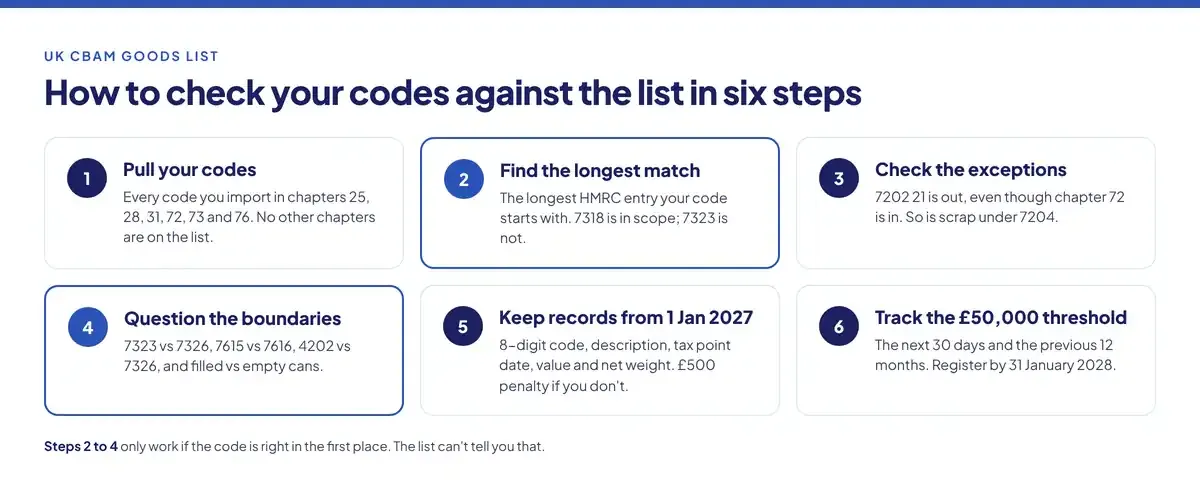
- Pull every commodity code you import into chapters 25, 28, 31, 72, 73 and 76. Those are the only chapters on the list.
- For each code, find the longest entry on HMRC's list that it starts with. A code starting 7318 is in scope; a code starting 7323 is not.
- Check it against the exceptions. A code starting 7202 21 is out, even though chapter 72 is in.
- Question the codes that sit near a boundary: 7323 against 7326, 7615 against 7616, 4202 against 7326, and filled against empty cans.
- For anything in scope, start recording the 8-digit code, description, the date the goods passed the tax point, customs value and net weight from 1 January 2027, and ask suppliers for emissions data. HMRC can charge a £500 penalty for failing to keep CBAM records.
- Work out when you cross £50,000. HMRC applies two tests: whether you expect to import £50,000 of CBAM goods in the next 30 days, and, on the first day of each month, whether you imported £50,000 in the previous 12 months. Registration opens on 1 January 2028, and if you became liable during 2027 you must register by 31 January 2028.
Step 2 only works if the code is right in the first place. The list tells you which codes are in scope. It can't tell you whether your product belongs under the code you have been using.
Where TariffTel fits
Every code classified in TTVerified is checked against CBAM and flagged when it is in scope, alongside anti-dumping duty and the duty and preferential rates. Codes come from expert-built question pathways, like the outer-surface question that caught the card holder, and a customs specialist verifies each one, so you can show HMRC why a product is or isn't a CBAM good.
If you have a range of metal products, packaging or fixings to check before January, start with the lines you are least sure of. The TTVerified 14-day free trial includes 10 classifications with no card needed, or talk to our classification team about reviewing a full range. For a single product, TTExplore suggests 10-digit codes with its reasoning from £2 a code.
FAQ

Elizabeth Davies
Elizabeth has more than 15 years’ experience in customs classification, advising UK retailers, manufacturers and food producers on getting commodity codes right and keeping them right. A regular speaker at Food and Drink Federation (FDF) webinars, she leads the team behind TariffTel’s expert-verified classification methodology.
Connect with Elizabeth on LinkedIn