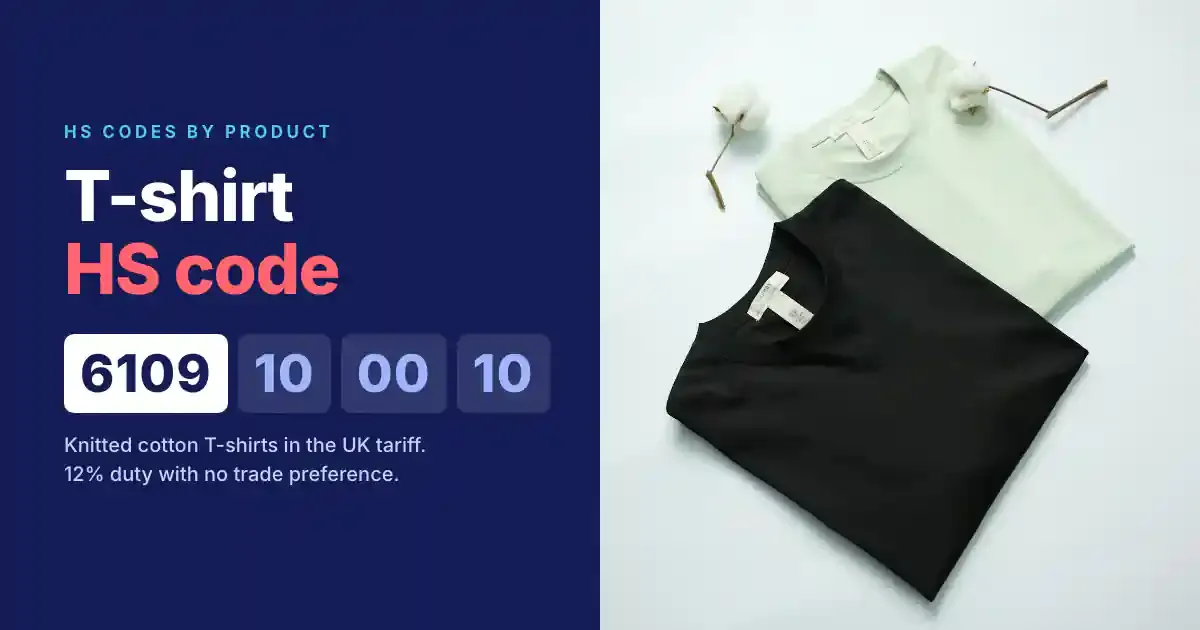
A knitted cotton T-shirt imported into the UK is classified under 6109 10 00 10, with a third-country duty of 12%. But the tariff's idea of a T-shirt is narrower than a retailer's. Lace decoration, a buttoned neck or a drawstring hem can move a "T-shirt" into a different heading. Here are the codes, the duty from each sourcing country, and the rules that decide it.
Key takeaways
- Knitted T-shirts of cotton are classified under 6109 10 00 10 in the UK tariff, with 12% third-country duty
- T-shirts of man-made fibres or wool go under 6109 90 20 00, also at 12%
- Men's and women's T-shirts share the same heading, 6109
- Lace decoration, any opening at the neckline, or a ribbed waistband or drawstring at the hem takes a garment out of 6109
- T-shirts from Bangladesh, Cambodia, Pakistan, India, Turkey and Vietnam can enter at 0% if the rules of origin are met; from China they pay 12%
The UK commodity code for a knitted cotton T-shirt is 6109 10 00 10. The third-country duty is 12%, and import VAT is 20%, or 0% for qualifying children's clothing. That covers most plain and printed T-shirts. The rest of this guide is about the garments that look like T-shirts but aren't, and the duty you pay depending on where they're made.
UK commodity codes for T-shirts
Checked on the UK Trade Tariff on 16 November 2026.
| Garment | Commodity code | Third-country duty |
|---|---|---|
| T-shirts, knitted, of cotton | 6109 10 00 10 | 12% |
| Singlets and other vests, knitted, of cotton | 6109 10 00 90 | 12% |
| T-shirts, singlets and vests of wool, fine animal hair or man-made fibres | 6109 90 20 00 | 12% |
| T-shirts, singlets and vests of other textile materials | 6109 90 90 00 | 12% |
| Women's or girls' blouses and shirts, knitted, of cotton | 6106 10 00 00 | 12% |
| Men's or boys' shirts, knitted, of cotton | 6105 10 00 00 | 12% |
T-shirts are knitted by definition, so there's no woven T-shirt heading. A woven top goes to 6205 (men's shirts) or 6206 (women's blouses and shirts). Note that 6206 30 00 00 isn't a declarable code: a woven cotton women's blouse goes under 6206 30 00 90.
What counts as a T-shirt
HMRC's textile classification guidance describes a T-shirt as a lightweight knitted or crocheted garment of cotton or man-made fibre, not napped and not of pile or terry fabric, with long or short sleeves, without buttons or other fastenings, without a collar and without an opening at the neckline. It can have pockets. It can be in one or more colours and carry printed or knitted decoration, such as pictures, words or advertising, but not lace.
The tariff notes add two more limits. Chapter 61 Note 5 excludes garments with a drawstring, ribbed waistband or other tightening at the bottom. And men's and women's T-shirts aren't separated: both go in 6109, which also covers singlets and vests.
When a T-shirt isn't a T-shirt
| Feature | Where the garment goes instead |
|---|---|
| Lace decoration | Women's blouses and shirts, 6106 (or men's shirts, 6105) |
| A button placket, zip or other opening at the neckline | Knitted shirts and blouses, 6105 or 6106 |
| A collar | Usually knitted shirts or blouses, 6105 or 6106 |
| A ribbed waistband or drawstring at the hem | Out of 6109; where it goes depends on the rest of the garment |
| Terry towelling or pile fabric | Out of 6109 |
| Woven fabric | Woven shirts and blouses, 6205 or 6206 |
| Long enough to wear without a lower garment | Dresses |
Here's how that plays out in practice. One of the pathways in our TTVerified demonstration is a women's top from Bangladesh, described by the supplier as "LADIES TEE LACE TRIM WHT S-XL". In the demonstration catalogue it had been declared as a T-shirt under 6109 10 00 10. TTVerified's question pathway asks which feature of a sleeved T-shirt applies, and "with lace decoration" moves it to 6106 10 00 00, women's blouses and shirts. The pathway also asks for the stitch count, because a knitted blouse under 6106 needs at least 10 stitches per centimetre in each direction.
The duty is 12% under either code, so the wrong code wasn't costing anything at the border. It was still a wrong declaration. And the code matters for rules of origin, preferences on other headings and any measure that applies by heading. As we noted in our guide to HS codes for clothing, clothing is one of the most misclassified categories we see.
Cotton, polyester or a blend
The fibre that makes up the greatest weight decides whether a T-shirt is "of cotton" or "of other textile materials". A T-shirt that is 95% cotton and 5% elastane is classified as cotton. A 100% polyester T-shirt goes under 6109 90 20 00.
Blends need more care. Section XI Note 2 classifies mixed textiles as if they were made entirely of the fibre that predominates by weight, with a separate rule for when no fibre predominates. A 50/50 blend is exactly the case to check carefully, or to ask HMRC about, before you declare.
UK duty on T-shirts by country of origin
The third-country rate is 12%, but most of the UK's main clothing suppliers have a preference. These rates are for 6109 10 00 10, checked on the UK Trade Tariff on 16 November 2026, and they apply only if the goods meet the rules of origin and you can prove it.
| Origin | Scheme | Duty |
|---|---|---|
| Bangladesh | Developing Countries Trading Scheme, comprehensive preferences | 0% |
| Cambodia | Developing Countries Trading Scheme, comprehensive preferences | 0% |
| Pakistan | Developing Countries Trading Scheme, enhanced preferences | 0% |
| India | UK–India trade agreement (in force since 15 July 2026) | 0% |
| Turkey | UK–Turkey trade agreement | 0% |
| Vietnam | UK–Vietnam trade agreement, or CPTPP | 0% |
| European Union | UK–EU Trade and Cooperation Agreement | 0% |
| China | No preference | 12% |
The rules of origin differ by scheme. Under the comprehensive tier of the Developing Countries Trading Scheme, for example, the rule for knitted garments is manufacture from fabric. Under the UK–Turkey agreement it is knitting combined with making-up, including cutting of the fabric. If the garment doesn't meet the rule, you pay 12%.
For comparison, a US importer pays a general rate of 16.5% on cotton T-shirts under US code 6109.10.00. The first six digits match the UK code, but the rate and the last four digits don't.
Before you declare
- Confirm the garment is knitted, not woven.
- Check it against the T-shirt definition: no collar, no neck opening, no lace, no tightening at the hem.
- Get the fibre composition by weight from the supplier's specification, not the swing tag.
- Choose the 10-digit code: 6109 10 00 10 for cotton T-shirts, 6109 90 20 00 for man-made fibres.
- Check the preference for the country of origin and hold the proof of origin before you claim it.
How TariffTel helps
TTExplore classifies a garment from a plain-English description and shows its workings: the chapter, heading and subheading, what decided each step and what would change the code. Its worked example for a men's 100% cotton crew-neck T-shirt lands on 6109 10 00 10, and notes that a polo collar would move it to 6105 and lace decoration on a women's T-shirt to 6106. From £2 a code.
For ranges that change every season, TTVerified asks the garment questions that decide the code, such as construction, fibre by weight, features and intended wearer, and a customs specialist verifies every code. The 14-day free trial includes 10 classifications. See how we work with fashion retailers on our fashion industry page, including the boohoo case study.
FAQ

Elizabeth Davies
Elizabeth has more than 15 years’ experience in customs classification, advising UK retailers, manufacturers and food producers on getting commodity codes right and keeping them right. A regular speaker at Food and Drink Federation (FDF) webinars, she leads the team behind TariffTel’s expert-verified classification methodology.
Connect with Elizabeth on LinkedIn