Clothing is typically one of the categories with the highest number of wrong classifications. Pay too little and HMRC will want the difference back. Pay too much and it is lost profit you never see.
Key takeaways
- Most clothing sits in Chapter 61 if knitted or crocheted, or Chapter 62 if woven, so construction is the first thing to confirm from the supplier specification
- The dominant fibre by weight sets the subheading, so a change as small as five percentage points can move a product to a new code and a new duty rate
- Bras, textile costumes and absorbent period wear sit outside the obvious headings, which is where most errors start
- Every code needs a written rationale: HMRC can recover underpaid duty going back three years, with interest and possible penalties
Clothing is typically one of the categories with the highest number of wrong classifications. If mistakes are made, you could find yourself paying too much or too little. Either way is a risk. Any shortfall on your part would have to be paid back to HMRC, and an overpayment is possibly something you will never know about. It is lost profit, never revealed.
Using the correct HS (Harmonized System) code means you pay just the right amount on the clothing or apparel you are importing or exporting. Without it, you are stabbing in the dark, guessing at the answer, paying a duty rate that may, or may not, be right.
This guide explains how to best approach classifying clothing, whether you are looking for a HS code for T-shirts, a shirt, or swimwear. We cover some of the common pitfalls in getting codes wrong, why HS codes matter in the design phase as well as the shipping phase, and what systems make the process easier.
What is a HS code?
A HS code is the commodity code that identifies a garment for customs. It sets the duty you pay, determines whether a trade agreement preference can apply and stipulates the checks that the goods require.
The code itself denotes various pieces of information. The first six digits are the international HS code, maintained by the World Customs Organization (WCO) and used by more than 200 countries. The UK uses eight digits for exports and ten digits for imports.
Note that clothes, apparel and garment are commonly used terms for all clothing types.
How does the tariff book classify garments?
Most clothing is covered in Chapter 61 (knitted or crocheted items) or Chapter 62 (woven items). Some garments, including bras, textile costumes and absorbent period wear, are addressed elsewhere.
Footwear codes are in Chapter 64. These codes are determined by the material used for the upper and outer sole, and whether or not the shoe meets the legal definition of waterproof.
As well as detailing codes, the chapters provide information on garment type, the intended wearer and the main fibre used.
HS codes for clothing are based on a specific set of criteria. In some cases, UK customs use a different word to denote an item of clothing than the more commonly used word. For example, a bikini top with defined cups is classified as a bra. There can also be confusion over garment terms used in the UK and US. A blouse, for example, refers to two visually different items and can often catch people out.
Every code requires a written rationale. HMRC does not accept “It has always been this code” or “ChatGPT said it was this code”. HS codes need supporting documentation and reasoning to stand up when questioned.
Understanding tariff codes: a women's bikini
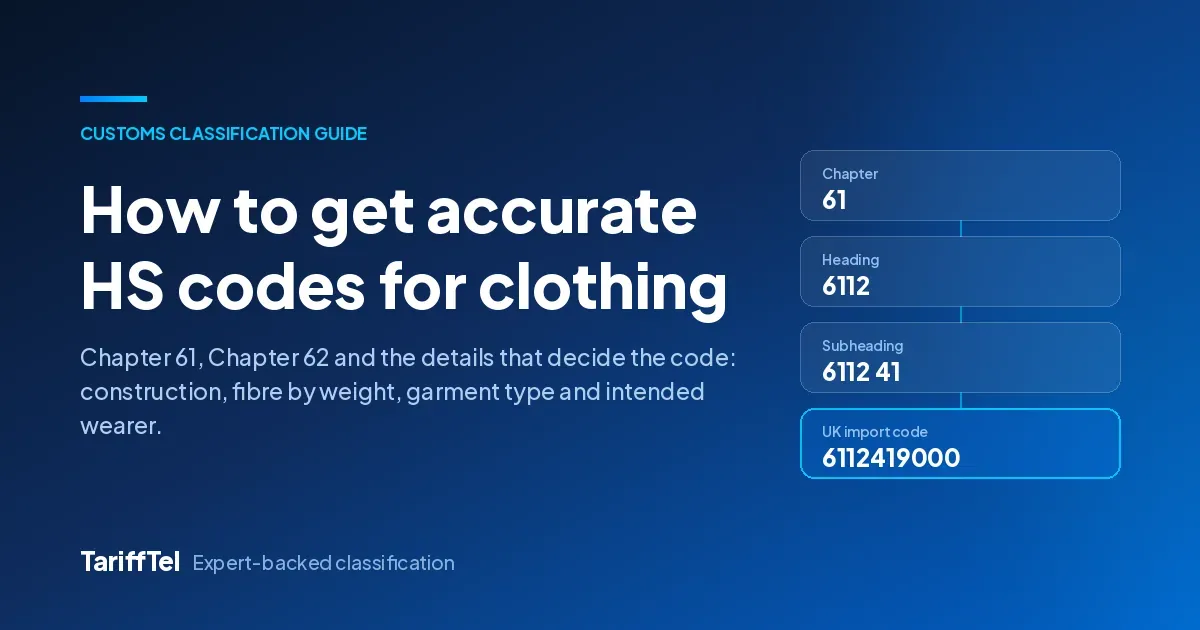
Here is how the UK import code for a knitted women's bikini in synthetic fibres breaks down.
| Level | Digits | What it tells you |
|---|---|---|
| Chapter | 61 | Articles of apparel, knitted or crocheted |
| Heading | 6112 | Tracksuits, ski suits and swimwear, knitted or crocheted |
| Subheading | 6112 41 | Women's or girls' swimwear, of synthetic fibres |
| UK import code | 6112419000 | The full ten-digit code declared on import |
Which HS chapters cover clothing and footwear?
Most garments sit in two chapters of the textiles section of the tariff. Footwear has its own chapter, and some clothing sits elsewhere entirely.
| Chapter or heading | What it covers | Examples |
|---|---|---|
| Chapter 61 | Apparel and clothing accessories, knitted or crocheted | T-shirts, jersey tops, jumpers, leggings, sweatshirts, polo shirts |
| Chapter 62 | Apparel and clothing accessories, not knitted or crocheted | Shirts, blouses, trousers, jeans, tailored jackets, coats, woven dresses |
| Chapter 64 | Footwear | Trainers, boots, sandals, heels |
| Chapter 65 | Headgear | Hats and caps |
| Chapters 39, 40, 42 and 43 | Articles of plastic, rubber, leather and fur | Leather jackets, rubber garments |
| Heading 9619 | Sanitary articles | Period knickers, period swimwear with an absorbent gusset |
| Heading 9505 | Festive and novelty articles | Non-textile novelty costumes, such as an inflatable Father Christmas suit |
Footwear codes in Chapter 64 depend on the upper and outer-sole materials, and on whether the shoe meets the legal definition of waterproof, which not every weatherproof-looking shoe does.
How do you classify clothing? What to consider
Classification is a legal process. Codes are determined by the General Rules of Interpretation (GRIs), six rules that set the order in which the tariff is read. For clothing, that means working through these steps.
- Read the heading texts and the section and chapter notes (GRI 1). These are legally binding. For clothing, they decide more than most people expect. A Father Christmas costume, for example, is classified as a garment, not as a festive article.
- Confirm construction and composition. Is it knitted or woven? What is the main fibre according to composition by weight? Is the fabric coated? All of this information can be found in the supplier specification.
- Identify the garment type and the intended wearer. HMRC's textile apparel guidance treats garments that close left over right at the front as men's or boys', and right over left as women's or girls'. Garments that cannot be identified as either go in the women's or girls' headings. Babies' garments are for infants measuring no more than 86cm in length.
- Check how sets and multi-part items are treated (GRI 3). Retail sets and multi-component items are assessed as a whole first.
- Narrow to the subheading (GRI 6). The same logic applies at each level, and this is where the dominant fibre by weight decides the answer. An HMRC Advance Tariff Ruling for a knitted polyester and elastane women's swimsuit used GRI 1 to reach heading 6112 and GRI 6 to reach subheading 6112 41.
- Check the Explanatory Notes and existing rulings. They explain what a heading covers and how similar goods have been classified.
- Record your reasoning. HMRC can recover underpaid duty going back three years, with interest and possible penalties.
What are Explanatory Notes and why do they matter for clothing?
Explanatory Notes are the WCO's commentary on each heading of the Harmonized System. They explain what each heading means and provide information on the main products covered. They set out what a heading includes and excludes, and give technical descriptions of the goods. The WCO describes them as “the official interpretation of the Harmonized System at the international level”.
They sit in a clear order of authority.
- Legally binding: the General Rules of Interpretation, the heading and subheading texts, and the section and chapter notes.
- Official interpretation: the WCO Explanatory Notes. They are not part of the legal text, but customs authorities rely on them to decide what a heading covers.
- Precedent and guidance: rulings such as UK Advance Tariff Rulings and EU Binding Tariff Information, and HMRC guidance such as the textile apparel guide, are all important points of reference.
Swimwear shows why this matters. The Explanatory Notes say swimwear includes “one piece or two-piece bathing costumes, swimming shorts, and trunks, whether or not elastic”. That wording is why a complete bikini set, and bikini bottoms sold on their own, classify as swimwear under 6112419000. A bikini top sold alone is classified on its design instead.
The Explanatory Notes are a paid WCO publication. AI cannot read the references that determine customs codes, and this is why general AI tools can get classification wrong.
Knitted, woven or something else? A decision path for garments
To determine the HS code, work through these questions in order.
- Is it footwear? Go to Chapter 64 and check whether the upper and the outer sole meet the definition of waterproof.
- Is it designed to absorb, such as period knickers or a swimsuit with an absorbent gusset? If so, it could fall under heading 9619 as a sanitary article, not in Chapters 61 or 62.
- Is it fancy dress? Textile costumes are classified as garments in Chapter 61 or 62. Non-textile novelty costumes, such as inflatables, can fall under heading 9505.
- Is the garment made of leather, furskin, plastic or rubber, rather than textile? Consult Chapters 42, 43, 39 or 40. Garments of coated textile fabric have their own headings, so check the coating before you decide.
- Is it a bra or similar supporting garment? It comes under heading 6212, irrespective of whether it is knitted or woven.
- Is the fabric knitted or crocheted? If so, go to Chapter 61. Woven, or a non-woven such as felt? See Chapter 62.
- What is the garment, and who is it for? The name of the garment type and intended wearer determine the heading.
- Which fibre makes up most of the item of clothing by weight? This sets the subheading.
How does fibre composition change a clothing HS code?
Chapters 61 and 62 show how fibre is determined by the dominant weight of a garment. A little elastane does not make a cotton top synthetic, but a blend with more polyester changes the subheading, and can affect the duty.
A change as small as five percentage points can move a product to a new code, so you need to know the exact composition by weight for every product line. Other items work the same way: a shirt made of knitted jersey is covered in Chapter 61, but a shirt made of woven poplin is in Chapter 62.
| Garment | Construction | Composition | Fibre that decides | Code |
|---|---|---|---|---|
| T-shirt | Knitted | Cotton | Cotton | 6109 10 |
| Women's top | Knitted | 95% cotton, 5% elastane | Cotton | 6106 10 |
| Bikini set | Knitted | 87% polyamide, 13% elastane | Synthetic fibres | 6112419000 |
| Bikini top, no defined cups | Knitted | Man-made fibres | Man-made fibres | 6114300000 |
| Men's shorts (swim shorts that do not meet the swimwear criteria) | Woven | Synthetic fibres | Synthetic fibres | 6203439000 |
Read more about the swimwear examples in when is swimwear not swimwear according to the tariff book, and on costumes in our 2026 Christmas classification guide.
Common clothing classification errors
- Classifying by product name. “Swim shorts”, “bikini top” and “costume” each have more than one possible code.
- Assuming construction from a photo. Knitted and woven can look alike. Confirm it with the supplier specification.
- Relying on marketing descriptions. “Cotton-rich” is not a composition. The code requires percentages by weight.
- Missing the chapter note exceptions. Bras, textile costumes and absorbent period wear do not come under the obvious heading.
- Treating a separate item like the set. A bikini top sold alone does not take the bikini set code.
- Inheriting codes. A code copied from a supplier invoice, a broker or last season's spreadsheet will not be accepted.
- Letting codes go stale. A new fabric, blend or supplier can alter the code, and there are tariff changes throughout the year. HS 2028 takes effect on 1 January 2028.
TariffTel and boohoo
When boohoo needed to ship its fast-fashion range from the UK to the US, TariffTel classified 20,000 SKUs in four months with a 100% compliance record, capturing construction, fibre composition and intended wearer for every line.
TariffTel sources the detail of each garment, such as construction, fibre weight and intended wearer. With this information, it quickly provides an expert-backed, audit-ready code with a full rationale. Read the full boohoo case study.
If you are classifying clothing or footwear and want codes that stand up when questioned, TTVerified combines automation with expert review and a full audit trail, or you can talk to our classification team.
FAQ

Elizabeth Davies
Elizabeth has more than 15 years’ experience in customs classification, advising UK retailers, manufacturers and food producers on getting commodity codes right and keeping them right. A regular speaker at Food and Drink Federation (FDF) webinars, she leads the team behind TariffTel’s expert-verified classification methodology.
Connect with Elizabeth on LinkedIn