Key takeaways
- Misclassification is not a low-risk error — it can trigger customs delays, fines or legal action
- Star Images Enterprises faced two C18 Post Clearance Demand Notices from HMRC over underpaid Customs Duty and Import Tax
- TTVerified supports accurate, compliant classification for even the most complex products
- Human expertise and interpretation remain essential alongside any classification technology
In reality, using incorrect codes can lead to customs delays, fines, or even legal action. Take the recent tribunal case between HMRC and Star Images Enterprises where Star Images Enterprises found itself facing two C18 Post Clearance Demand Notices from HMRC for the underpayment of Customs Duty and Import Tax. This is a stark reminder of the importance of human expertise and interpretation in classification.
It’s crucial for businesses to prioritise the correct classification of goods to avoid these types of potential complications and financial risk. That’s where our TTVerified platform comes in to support businesses in accurate and compliant classification for even the most complex of products, supported by the guidance of our customs experts.
Here we look at the unexpected consequences of misclassifying goods and the repercussions it can have across a business if you’re found to be non-compliant by the government.
What is customs misclassification?
Customs misclassification is assigning the wrong tariff code, also called an HS or commodity code, to a product you import or export. That code decides the duty rate you pay, the import taxes due, and the controls, licences and documentation that apply. Get it wrong and every figure built on it is wrong too.
It is more common than most businesses think. When we audit new customers, we typically find that 2 in every 5 tariff codes are incorrect. Misclassification is rarely deliberate. It usually comes from vague product descriptions, codes inherited from a supplier or broker, or a code that was right once but was never updated when the rules changed. The consequences, though, are the same whether the error was honest or not.
A tariff code is not just a label, it is a legal determination. The first six digits are the Harmonised System code used worldwide, and the UK and EU add further digits to set the exact duty rate and any controls. Because a change of a single digit can move a product into a different duty band, a licence requirement or a prohibition, classification has to be evidence-led. That is the gap misclassification falls into: a plausible-looking code that the product detail does not actually support.
HMRC penalties for incorrect tariff codes
Customs misclassification penalties in the UK fall into two routes: civil and criminal. Most cases are civil, dealt with through penalties and demands for underpaid duty. Deliberate, dishonest evasion is treated as a criminal matter. The table below sets out the difference.
| Civil route | Criminal route | |
|---|---|---|
| When it applies | Mistakes, carelessness or failing to follow customs rules | Deliberate, dishonest evasion of duty |
| Penalty for the contravention | £250 to £2,500 per contravention under Customs Notice 301 | Prosecution, not a fixed sum |
| Repaying the duty | Back-duty and import VAT demanded via a C18 notice, usually up to 3 years (up to 20 if deliberate) | Full repayment on top of any sentence |
| Evasion penalty | A civil evasion penalty of up to 100% of the duty evaded, as an alternative to prosecution | Not applicable |
| Worst case | Escalating financial penalties, lost time and AEO status at risk | An unlimited fine and up to 7 years in prison |
On top of any penalty, HMRC can demand the duty you should have paid, usually going back up to three years, and up to twenty years where an error is judged deliberate. Coming forward with a voluntary disclosure before HMRC finds the error usually reduces the penalty.
In practice, most businesses first meet this as a C18 Post Clearance Demand Notice, HMRC’s formal demand for the duty and import VAT that should have been paid. How the penalty is set depends on behaviour: an honest mistake made with reasonable care attracts the lightest treatment, carelessness more, and deliberate concealment the most. That is why documentation matters so much. Being able to show the reasoning behind a code is often the difference between a reduced penalty and a heavy one.
Repaying underpayments of duty
Underpayments of duty can lead to businesses having to repay the shortfall that should have been initially paid to customs authorities. This is often a meticulous and complex procedure that includes a thorough review of the misclassified products and the subsequent calculation of the correct tariff codes and associated duties, taking up both time and resource from elsewhere in the business. The financial impact of repaying underpayments extends beyond the actual duty amount. There are additional costs associated with conducting internal audits, hiring customs experts or consultants to rectify the misclassification, and possibly engaging legal support to navigate the complex regulatory landscape.
Associated fines with noncompliance
Customs authorities take tariff code accuracy seriously, and any errors can result in penalties that can put strain on a company’s financial resources. These fines are not just nominal; they can escalate rapidly, especially if the misclassification is considered a deliberate attempt to evade duties.
Potential loss of Authorised Economic Operator (AEO) status
AEO status is a coveted designation that provides companies with various benefits, including simplified customs procedures and reduced scrutiny. Losing this status could result in increased administrative burdens, longer processing times, and additional costs associated with adhering to standard customs procedures.
Further audits to ensure future compliance
Following a misclassification of goods, businesses may find themselves subjected to further audits by government authorities to ensure future compliance with customs regulations. This means that customs authorities scrutinise a company’s import and export activities in-depth, aiming to identify any potential irregularities, errors, or intentional noncompliance. These audits typically involve a meticulous examination of the company’s documentation, including customs declarations, invoices, and other relevant records. The impact of these audits is significant. The company may incur additional costs associated with the preparation of documentation, engagement of specialised consultants, and potential legal expenses to navigate the audit process.
Damage to company reputation
Repeated instances of noncompliance may lead to a damaged reputation within the industry. Customers, partners, and stakeholders may view the company with increased scepticism, potentially affecting its competitiveness and market position. The repercussions extend beyond the immediate financial and operational challenges, and can impact the long-term viability and sustainability of a business.
Real cases: the cost of getting it wrong
The numbers are not hypothetical. In September 2025 the First-tier Tribunal upheld a 4.7 million pound liability against Morrisons over the declared origin and anti-dumping treatment of imported aluminium foil, ruling that a factory arrangement in Thailand did not meet the rules. It is a reminder that origin and classification errors reach even the largest, best-resourced importers. We break the ruling down in our guide to the Morrisons case.
The Morrisons ruling turned on non-preferential origin and an anti-dumping rule rather than a simple code swap, but the lesson is the same: customs looks past the paperwork to the substance of a product and where it really comes from. If your origin evidence or your classification cannot withstand that scrutiny, size and good intentions are no protection.
Smaller businesses are caught too. In the tribunal case between HMRC and Star Images Enterprises, the company faced two C18 Post Clearance Demand Notices for underpaid Customs Duty and Import Tax, a stark reminder of how much rides on getting both the code and the interpretation right.
The same pattern shows up in everyday ranges. Take a common scenario: a toy importer ships a battery-powered ride-on under a generic toy code, when the electric motor and battery move it into a different heading with a higher duty rate and extra safety requirements. The code had always been used, so nobody checked. The correction, when it came, meant back-duty across several years plus a penalty. Near enough is never good enough.
What these cases share is not carelessness so much as the absence of a system. In each, the code looked reasonable, the paperwork was filed, and no one had the data, the rules or the audit trail to catch the error early. Misclassification is rarely a single bad decision. It is the lack of a process to question a code before customs does it for you.
How misclassification erodes profit margin
The most expensive misclassifications are often the quiet ones. A wrong code does not always trigger a fine straight away. More often it sits in your systems, quietly overpaying or underpaying duty on every single shipment.
Overpay, and you hand money to customs you never needed to, month after month, straight off your margin. Underpay, and you are building a liability that grows until HMRC notices. Either way, the code feeds your landed cost, your pricing and your forecasts, so a single wrong digit can distort the numbers a whole business runs on.
A simple illustration shows the scale. On a 250,000 pound annual import stream, sitting under a 6% duty code when the correct rate is 2% quietly costs an extra 10,000 pounds every year. Reverse the error and underpay by the same margin, and you are accruing a 10,000-pound-a-year liability that HMRC can reclaim, with a penalty on top. Same mistake, opposite direction, both expensive.
2 in every 5 tariff codes are wrong. When we review a new customer's codes, that is what we typically find, and those errors can compound across thousands of declarations for years before anyone notices.
Why you should regularly review your existing codes
It has always been this code is one of the most expensive phrases in trade compliance. Codes are not fixed. The World Customs Organisation updates the Harmonised System every five years, with HS 2028 next, and HMRC and the EU issue binding rulings and interim updates in between that quietly move products from one heading to another.
Inherited codes are just as risky. Many businesses ship on codes chosen by a supplier or broker years ago, on evidence no one can now find. A regular review, checking your highest-volume and highest-duty products against the current tariff, is the cheapest insurance there is against a back-duty letter.
A review does not have to mean re-classifying everything at once. Start with the products that carry the most duty and the highest volumes, the ones where an error costs the most, and work down from there. Pair that with an alert the moment a relevant code changes and you move from finding errors years later to catching them before they ship.
The 5 most common classification mistakes
Most misclassification traces back to the same handful of errors: underestimating how wrong a code can be, classifying by hand or with ChatGPT, assuming a code never changes, thinking low volume means low risk, and leaving it all to your broker. We break down each one, with examples, in our guide to the five customs classification mistakes that mean fines. Recognising which one your business is most exposed to is usually the fastest way to cut your risk.
How to avoid misclassification
Avoiding misclassification is less about effort and more about process. Put these in place and most errors never happen:
Capture full product data at source. Composition, materials, function, dimensions and origin, from the people who know the product best, your suppliers.
Apply the rules, not guesswork. Work through the General Rules of Interpretation and check the chapter and section notes, rather than copying the nearest-looking code.
Keep an audit trail. Record what data was used, which rules were applied and who signed the code off, so it stands up if HMRC asks.
Review when the rules change. Re-check codes at each HS update and after relevant HMRC rulings.
Get complex and high-value items expert-verified. These are where the costly errors hide.
Do not rely on a single free tool or an unchecked broker submission. The liability is yours, so the check should be too.
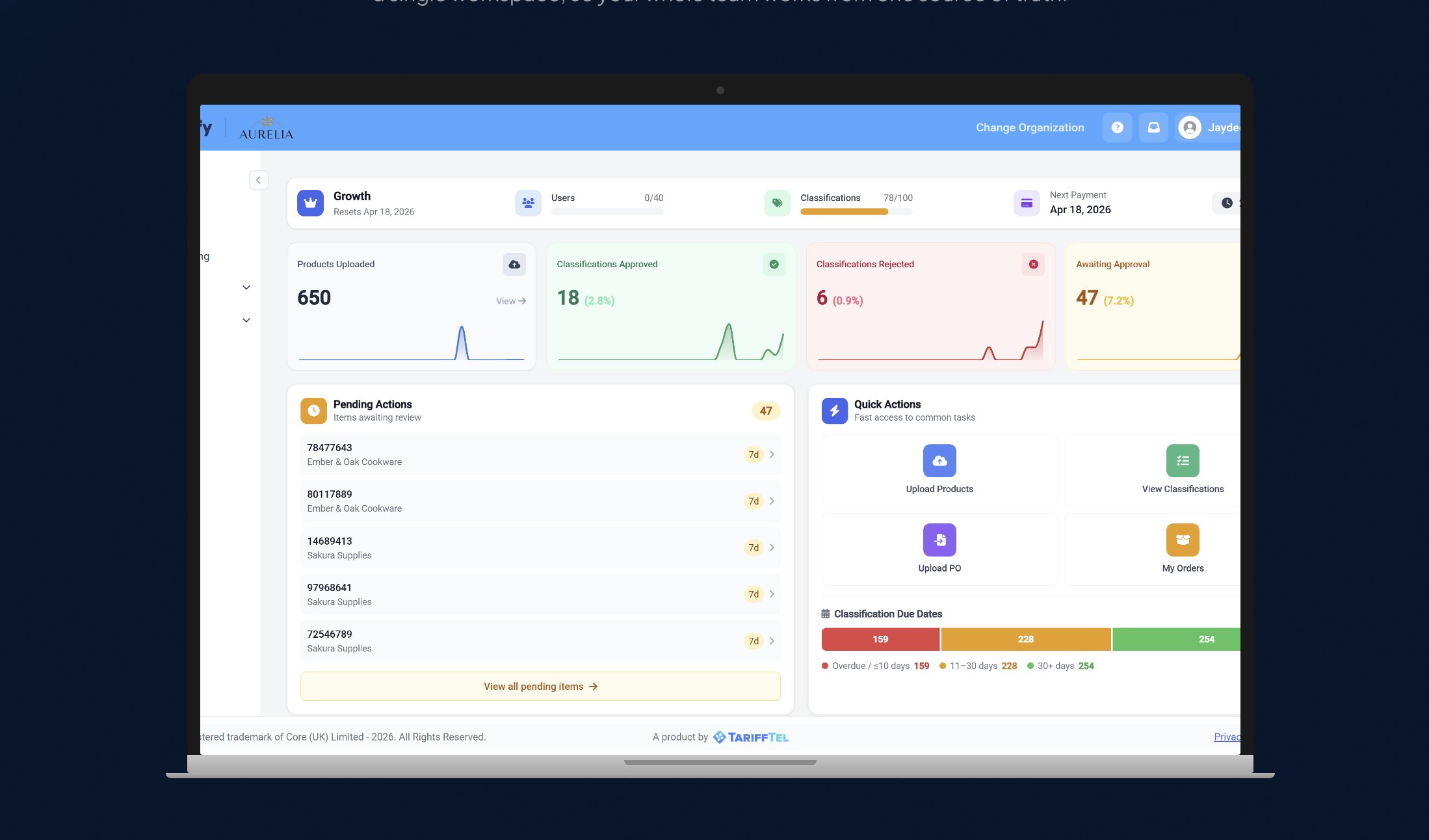
That is exactly how TariffTel is built. TTExplore gives you fast, self-serve code suggestions to check, TTVerified adds expert verification and a full audit trail, and our Managed Services team can classify and maintain your whole inventory for you. This is precisely where TTVerified adds value — expert-backed, audit-ready classification at scale.
None of this is about doing more work. It is about doing the classifying once, properly, and being able to prove it.
FAQ
TariffTel’s combination of advanced customs data and our expert classification team create a precision solution for every business prioritising trade efficiency and growth.
If you want to find out more about a tariff code solution that’s right for your business or want to learn how your business could benefit from TariffTel, get in touch with our team.