A commodity code is possibly the smallest decision in your supply chain, and one of the most expensive to get wrong. This guide explains what tariff classification software actually does, why the shortcuts most businesses reach for keep failing, and how to choose a tool that gets codes right and keeps them right.
Key takeaways
- A commodity code is a live compliance decision, not a one-off label — it changes when your product changes or the tariff does.
- Spreadsheets, ChatGPT, lookup tools and per-line brokers can all produce a code. None reliably produces one you can defend.
- Real classification software captures structured product data, proposes a code against live tariff data, has a human verify it, and keeps an audit trail.
- Start with the must-have tier — live tariff data, human verification, audit trail, change monitoring — before adding analytics.
- Around 2 in 5 commodity codes TariffTel has audited come back wrong, at up to £2,500 per HMRC contravention.
The Harmonized System underpins over 98% of world merchandise trade, and it is revised every five years — the 2022 edition alone carried 351 sets of amendments across 49 of its 97 chapters. In 2028, the next major update lands with an expected 299 sets of amendments, 1,229 headings and 5,852 subheadings, likely touching almost every UK business that ships internationally, from electronics to pharmaceuticals to green technology. The UK Trade Tariff runs to roughly 25,000 commodity codes, and import declarations require the full 10-digit code. UK customs declarations passed 70 million in 2024, more than triple pre-2021 levels. Across the products TariffTel has audited, around 2 in 5 commodity codes come back wrong, and HMRC penalties run to up to £2,500 per contravention.
A commodity code is possibly the smallest decision in your supply chain, and one of the most expensive to get wrong. It sets the duty rate you pay, the documents you need, the controls that apply, and whether your goods clear the border or sit at it. Get it right and nobody notices. Get it wrong and the cost surfaces months later, in a back-duty letter, a held shipment, or a margin that was never really there.
The catch is that classification was never designed to be easy. The Harmonized System sorts every traded product on earth into around 5,000 six-digit groups, and the UK then extends those to a 10-digit code for imports. The rules behind them run to thousands of pages of legal notes, and they change. This is the problem tariff classification software exists to solve.
At TariffTel we have spent over 15 years classifying products for businesses where getting it wrong is not an option, from independent food and drink producers to household-name retailers. Over that time we have classified more than 1.5 million products. This guide explains what classification software actually does, why the shortcuts most businesses reach for keep failing, and how to choose a tool that gets codes right and keeps them right.
Why does tariff classification matter more than ever?
A tariff code is not a label you set once. It is a live compliance decision that changes every time your product changes or the nomenclature does, and almost right is completely wrong.
Three things have made classification harder and riskier at the same time. First, volume. UK customs declarations passed 70 million in 2024, more than triple the level before 2021. Every one of those declarations needs a code, and every code is a decision someone has to stand behind.
Second, change. A code that was correct when you onboarded a product can quietly become wrong without you touching the product at all. The Harmonized System is updated on a five-year cycle, and the 2028 edition is expected to carry 299 sets of amendments across 1,229 headings and 5,852 subheadings. Every business that imports goods will need to review and potentially reclassify significant portions of its product range — and while that might seem a long way off, the time to get ready is now. Reclassifying that volume of products manually, on spreadsheets, could take months.
Third, scrutiny. Customs authorities can reassess duty years after a declaration. A wrong code is not a one-off error, it is a liability that compounds across every shipment until someone finds it. Importers routinely overpay duty through misclassification, and underpayment carries penalties on top of the duty owed. Either way, the business pays.
This is why classification has moved from a back-office task to a margin and compliance issue — and why doing it on a spreadsheet, or by pasting a product description into a chatbot, stopped being good enough.
What is HS code and tariff classification software?
Tariff classification software is a tool that works out the correct commodity code for a product, records the reasoning behind it, and keeps that code current as rules change. The better systems do four jobs: they capture accurate product data, propose the right code against live tariff data and legal notes, let a human verify the decision, and hold an audit trail you can show a customs authority.
To see why that matters, it helps to understand what a code actually is. A UK import commodity code is 10 digits, and each part comes from a different place:
- Digits 1 to 6 — the Harmonized System subheading, the global product category, controlled by the World Customs Organization and used by 200+ countries
- Digits 7 to 8 — the Combined Nomenclature, a regional sub-division controlled by UK/EU tariff schedules
- Digits 9 to 10 — the national subdivision used for duty, VAT and controls, controlled by HMRC in the UK Trade Tariff
Exports use the first 8 digits; imports need all 10. The first six are the same the world over, which is why a code is the common language of cross-border trade. It is also why a small error early in the number cascades into the wrong duty rate, the wrong controls and the wrong paperwork.
Why software, not just a database?
A lookup tool can show you the codes that exist. It cannot decide which one is right for your product, defend that decision, or tell you when it has changed. Classification software is the difference between searching and deciding.
— Elizabeth Davies, Head of Customs Classification & Compliance, TariffTel
Why do generic tools and manual methods get classification wrong?
Most businesses do not have a single classification method. They have a patchwork, and each part fails in its own way.
- Spreadsheets and inherited codes — store the codes a product was given at onboarding. No one remembers the reasoning; codes are copied from a supplier invoice or a former colleague and never re-checked.
- ChatGPT and general AI — generate a plausible code from a description. Confident, fast, and frequently wrong. No legal basis, no audit trail, no accountability if it is challenged, and often built on out-of-date data.
- Lookup and search tools — return the codes that match keywords, then hand you five plausible options and leave the decision, and the risk, with you.
- Freight forwarder or broker — classifies per line, often at speed. Inconsistent between shipments, rarely documented, and priced per line so the cost scales with your range.
- “It has always been this code” — keeps shipping on a code set years ago. Survives right up until the audit; past use is not a defence a customs authority accepts.
ChatGPT will give you a code. Our testing repeatedly reveals it will not give you the right code. The same is true of any tool that produces a code without a basis you can show and a human who will stand behind it.
— Elizabeth Davies, Head of Customs Classification & Compliance, TariffTel
The common thread is accountability. Every method above can produce a code. None of them, on its own, produces a code that is correct, consistent and defensible. That gap — between a code and a code you can defend — is the whole problem.
How does tariff classification software actually work?
“Automated” and “AI-powered” get used loosely. Plenty of tools automate the search and call it classification. Real classification software does something harder: it turns scattered product knowledge into a defensible decision, and keeps that decision alive as the rules move. Here is how the better systems work, stage by stage.

1. Capture product data at source
The code is only as good as the data it is based on. Good systems capture the attributes that actually drive classification — what it is made of, how it is processed, its composition or function — rather than guess from a product name. For a chocolate product that means cocoa content and sugar band; for a textile it means fibre and construction.
2. Suggest the code against live tariff data
With the right data captured, the system proposes candidate codes against current tariff data, legal notes and classification precedent. AI does the heavy lifting here, narrowing thousands of possibilities to the few that genuinely apply.
3. Verify the decision with a human expert
This is the step that separates a guess from a classification. A specialist validates the code, resolves the genuinely hard borderline cases, and records the reasoning. Accuracy comes from the data and the people who built the logic, not from the model alone — AI suggests, an expert verifies.
4. Keep an audit trail, and keep the code current
Every decision is recorded with its documentation, so when a customs authority asks why a product sits under a code, the answer is already there. And because codes change, the system flags products affected by a tariff update rather than leaving you to discover the change in a penalty notice.
Ask what triggers a code to update. If the honest answer is 'a human remembers to check', that connection will fail under pressure. The architecture has to make verification and notifications automatic, not optional.
— Elizabeth Davies, Head of Customs Classification & Compliance, TariffTel
Manual, broker, AI-only or expert-verified: which approach makes sense?
There is no single right answer, only the approach that fits your range, your risk and your growth. The market splits into two unsatisfying halves: an AI-only tool that asks you to trust the model, and manual services that ask you to trust the broker.
- Spreadsheets / manual — best for very small ranges with low change. No defensible audit trail, doesn't keep codes current.
- Broker, per line — best for occasional, complex one-offs. Rarely documented, only stays current when re-engaged.
- AI-only tool — best for speed and low cost on low-risk goods. No basis to show, sometimes keeps codes current.
- Lookup / search tool — best for finding possible codes to research. No audit trail — the decision is yours — and doesn't keep codes current.
- Expert-verified platform — best for growing ranges that need to be right and provable. Defensible on every code, and keeps codes current.
The pattern is clear. The cheap, fast options carry the decision risk back to you. The thorough options remove that risk but, done the old way, do not scale. Expert-verified platforms have emerged because they aim to do both: the speed of software with the defensibility of a specialist behind every code.
The cheapest classification is the right one, first time. The expensive one is the wrong code you discover eleven months later, in a back-duty letter, across every shipment you sent in between.
— Elizabeth Davies, Head of Customs Classification & Compliance, TariffTel
What should HS code classification software actually do?
Not every business needs every feature. Start with the must-have tier and only build up when the foundation is solid.
Must-have capabilities
- Classification against live tariff data — codes reflect the current tariff, not a snapshot that is already out of date
- Human verification of AI suggestions — a suggestion is not a decision; verification is what makes a code defensible
- Full audit trail on every code — when a customs authority asks why, the reasoning is already recorded
- Change monitoring and re-classification flags — products affected by a tariff update are surfaced before they cost you
- Structured product data capture — codes are based on the attributes that drive classification, not a product name
High-value capabilities
- Landed-cost visibility — duty and origin decisions made on real figures, not estimates
- Bulk upload and range-level classification — a season of new SKUs handled at once, not line by line
- Supplier and team collaboration — the people who know the product feed the data directly, at source
- Export to ERP, PLM, broker or customs systems — codes flow into the systems that use them, without re-keying
- Preference and origin analysis — identifies duty savings where trade agreements apply
Advanced capabilities
- Anomaly detection across the catalogue — flags inconsistent or outlier codes before they become audit findings
- Multi-market classification — manages codes across the markets you import to and export from
- Duty and landed-cost scenario modelling — tests sourcing and pricing decisions before they are committed
- Compliance reporting dashboards — turns classification data into a board-level view of exposure and saving
Build to the must-have tier first. A system that classifies accurately, verifies the decision and keeps an audit trail delivers more value than one stuffed with analytics sitting on unreliable codes. Get the foundation right, then add sophistication.
— Elizabeth Davies, Head of Customs Classification & Compliance, TariffTel
How do you choose the right tariff classification software?
Most vendor demos look impressive. The way to tell a real classification tool from a confident search box is to ask a handful of pointed questions and watch how cleanly they are answered.
- Is a human verifying the AI's suggestion, or am I trusting the model? If there is no verification step, you are buying a guess at speed.
- Can you show me the audit trail for a single code? If the reasoning is not recorded, it does not exist when a customs authority asks.
- What happens when the tariff changes? If the answer relies on someone remembering to re-check, your codes will drift.
- How is product data captured? Classification turns on attributes, not names — the tool should ask the questions the code depends on.
- Does it scale with my range without scaling my cost line by line? Per-line pricing punishes growth.
- Where has this tool been proven? Ask who already trusts it, and at what scale.
A good tool answers all six. A weak one will be strong on speed and vague on accountability. For classification, accountability, accuracy and trust is the product.
How TariffTel approaches classification
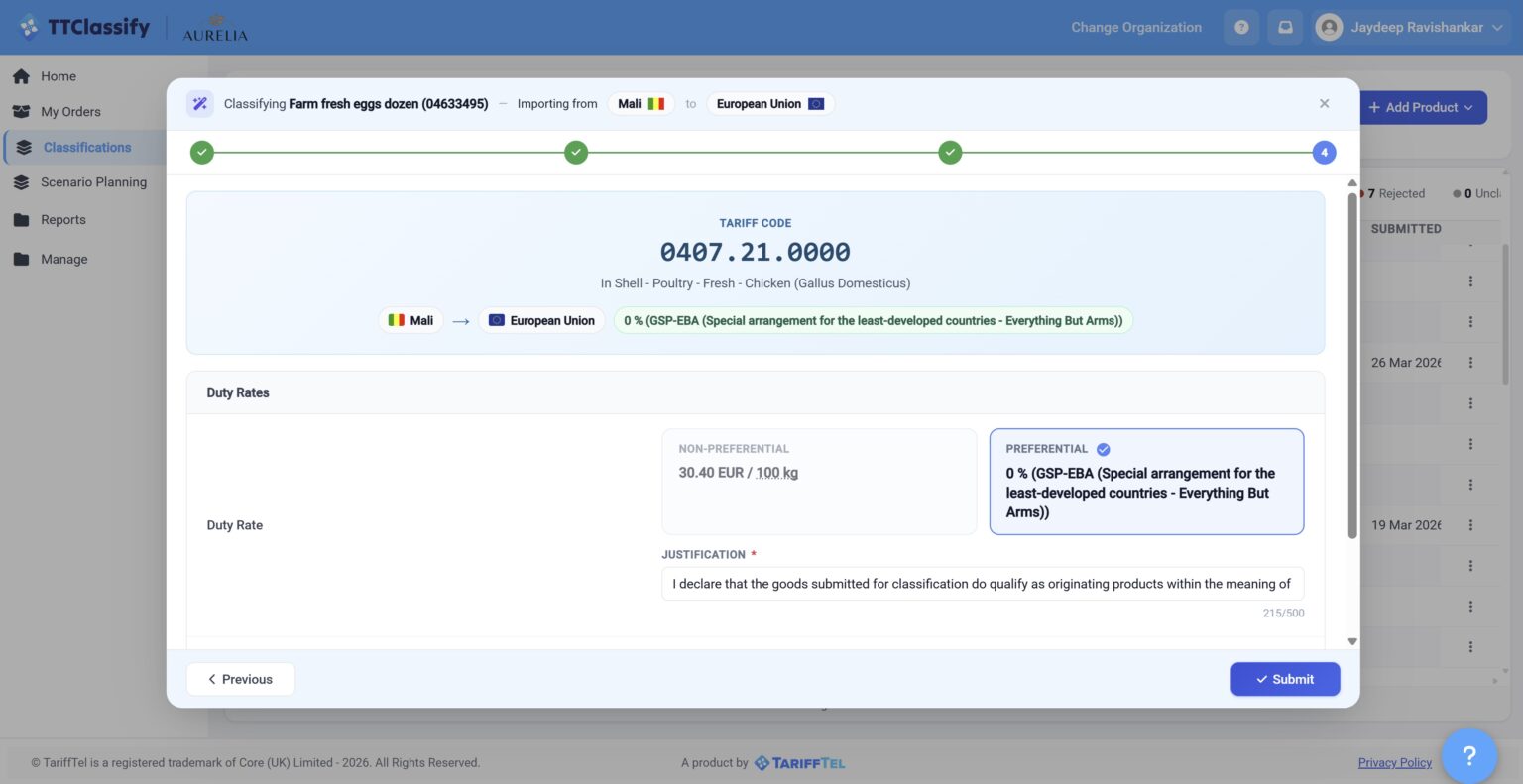
We built TariffTel around a single conviction: a code is only as good as the reasoning behind it. The platform pairs codes with expert verification, captures the product data classification actually depends on, and records an audit trail on every decision. It is the same engine that classifies for household-name retailers including M&S, ASDA, Primark and Portwest, and that has now classified more than 1.5 million products.
For teams that want to classify themselves, TTVerified is our self-serve platform: expert-backed, audit-ready codes, five minutes to sign up. TTExplore gets you three HS code options quickly with confidence scores — you decide. You know your products. We will handle the codes.
Whether you classify in-house, lean on a broker, or have never audited your codes at all, the principle holds: get the code right first time, keep it current, and be able to prove it. It all starts with an accurate tariff code.
Summing up
Tariff codes are governed by thousands of pages of legal notes, they change on a five-year cycle, and the cost of getting one wrong compounds across every shipment until someone catches it. Generic tools, manual approaches and inherited spreadsheets all produce and manage codes to a degree. None of them, alone, produces a code you can defend and rely on.
Good tariff classification software closes that gap. It captures the right data, suggests the right code, has a human verify it, keeps an audit trail, and flags the code when the rules move. The approach you choose should match your range, your risk and your ambition, but the bar is the same for everyone: right first time, kept current, defensible on demand.
If you have never audited your commodity codes, that is the place to start. On our numbers, around 2 in 5 come back wrong, and each one is quietly costing you.
Key takeaways
- A commodity code is a live compliance decision, not a one-off label — it changes when your product changes or the tariff does.
- Spreadsheets, ChatGPT, lookup tools and per-line brokers can all produce a code. None reliably produces one you can defend.
- Real classification software captures structured product data, proposes a code against live tariff data, has a human verify it, and keeps an audit trail.
- Start with the must-have tier — live tariff data, human verification, audit trail, change monitoring — before adding analytics.
- Around 2 in 5 commodity codes TariffTel has audited come back wrong, at up to £2,500 per HMRC contravention.
Test your own codes
If you are not sure your commodity codes are right, the fastest way to find out is to check a few. Talk to the TariffTel team about auditing your full range, or explore our product range to find the best fit.
FAQ

Elizabeth Davies
Elizabeth has more than 15 years’ experience in customs classification, advising UK retailers, manufacturers and food producers on getting commodity codes right and keeping them right. A regular speaker at Food and Drink Federation (FDF) webinars, she leads the team behind TariffTel’s expert-verified classification methodology.
Connect with Elizabeth on LinkedIn