From 14 December 2027, products made with forced labour cannot be sold in the EU or exported from it. What it means for HS codes and customs declarations is not yet fully clear. What is clear is that businesses need to know where and how their products are made.
Key takeaways
- From 14 December 2027, products made wholly or partly with forced labour cannot be placed on the EU market or exported from it.
- The ban covers every sector, every country of origin and every size of business, including UK businesses selling into the EU.
- Customs do not investigate forced labour. They act on bans issued by competent authorities and use risk management to find matching shipments.
- Nothing changes on customs declarations yet, but the Commission can require manufacturer, producer and supplier details for higher-risk product groups in future.
- Being unable to trace where a product or ingredient came from can count against a business, so supplier and composition data needs to be in order now.
From 14 December 2027, products made with forced labour cannot be sold in the EU or exported from it. Whilst it's not fully clear what implication this has for assigning HS codes and completing customs declarations, what is clear is that businesses need to know where and how their products are made.
What is the EU forced labour ban?
Regulation (EU) 2024/3015 stops businesses placing or making available on the EU market, or exporting, any product made in whole or in part with forced labour. It covers every sector and every country of origin, including goods made inside the EU, and there is no company size threshold. It's coming in from 14 December 2027.
The Commission's guidelines explain how authorities expect to apply the rules, yet how enforcement will work in practice is still to be determined.
How will customs enforce it?
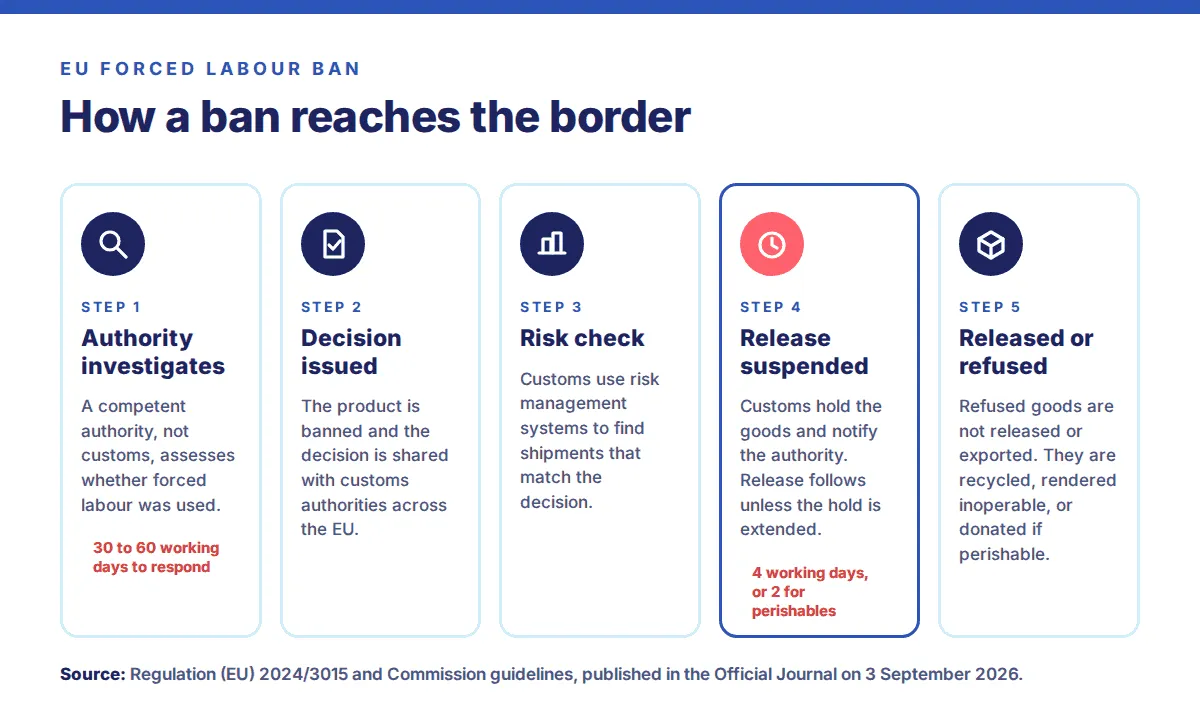
Customs do not decide whether forced labour was used. That is for the competent authorities. When an investigation finds a breach, the authority issues a decision banning the product, and that decision is sent to customs authorities across the EU.
Customs then use their risk management systems to find shipments that match a decision.
Does anything change on customs declarations?
Not yet. No extra data is needed on import or export declarations today. The regulation does allow the Commission to require manufacturer, producer and supplier details for specific product groups in future, chosen on the basis of risk.
Why is supplier information the part that takes time?
If an authority opens an enquiry, a business will be given at least 30 working days, and no more than 60, to respond. The guidelines are clear that being unable to provide traceability information, where a product or ingredient may have been mixed with one at high risk of forced labour, can count against a business. The Commission is also building a forced labour risk database covering products and geographic areas, which is still in development.
For food and drink, where one product can draw on dozens of ingredients from several countries, mapping who made what, and at which site, is a difficult task. Data about your products' composition has to be rigorous, provided by your suppliers and stored within a platform like TTVerified, which relies on this level of precise data to assign the correct HS code.
Does it affect UK businesses?
Yes, if you sell into the EU. The ban applies to products placed on the EU market wherever they were made, so UK manufacturers and exporters supplying EU customers can be named in a decision. The regulation does not apply to goods imported into Great Britain.
Key takeaways
- From 14 December 2027, products made wholly or partly with forced labour cannot be placed on the EU market or exported from it.
- The ban covers every sector, every country of origin and every size of business, including UK businesses selling into the EU.
- Customs do not investigate forced labour. They act on bans issued by competent authorities and use risk management to find matching shipments.
- Nothing changes on customs declarations yet, but the Commission can require manufacturer, producer and supplier details for higher-risk product groups in future.
- Being unable to trace where a product or ingredient came from can count against a business, so supplier and composition data needs to be in order now.
Get your product data in order before December 2027
Your HS codes and your forced labour exposure depend on the same thing: precise, supplier-backed product data. TTVerified gathers composition data from your suppliers, assigns expert-backed codes and keeps the full audit trail, so the evidence is there when you need it. Speak to our team about getting ready.
FAQ

Elizabeth Davies
Elizabeth has more than 15 years’ experience in customs classification, advising UK retailers, manufacturers and food producers on getting commodity codes right and keeping them right. A regular speaker at Food and Drink Federation (FDF) webinars, she leads the team behind TariffTel’s expert-verified classification methodology.
Connect with Elizabeth on LinkedIn