Accurate HS code classification is one of the few operational levers food and drink businesses still control directly. The right code protects margin, unlocks Free Trade Agreement preference, and shapes total landed cost.
Key takeaways
- HS codes are the global language of customs: the first six digits are identical in 200+ countries, while the final digits (10 in the UK) determine your actual duty, VAT and import measures.
- For food and drink, classification turns on composition by weight, processing state, sweetening, threshold values (cocoa, sugar, milk fat, juice) and packaging — not just what the product is called.
- Get the chapter right first (for example Chapter 09 vs Chapter 21) and the rest of the code falls into place far more easily.
Why accurate HS code classification matters for food and drink?
Accurate HS code classification is one of the few operational levers food and drink businesses still control directly. The right code protects margin, unlocks Free Trade Agreement preference, and shapes total landed cost.
The wrong code can trigger fines, a held shipment, or lost margin on products with the wrong duty rate.
In May 2026, Elizabeth Davies, TariffTel's Head of Customs Compliance and Classification, delivered a webinar with the Food and Drink Federation on exactly this. This guide is a practical resource on how to get food and drink classification right. And how to save money and time as a result. Platforms like TTVerified catch exactly this kind of nuance, combining automation with expert review.
What is an HS code?
A HS code is a number assigned to every product that crosses an international border. HS stands for the Harmonised System, the international classification language for traded goods, maintained by the World Customs Organisation and used by more than 200 countries. The code identifies what the product is, what it is made of, and how it is prepared.
How the digits are structured
The code itself is a hierarchy of digits, each adding precision:
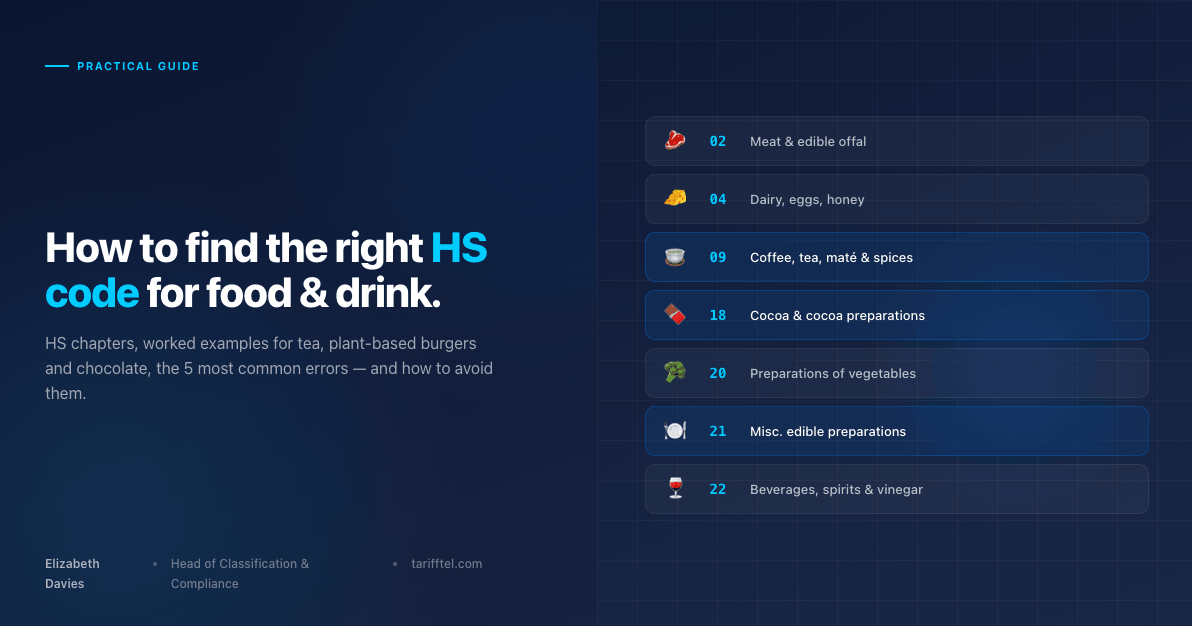
The first 2 digits identify the chapter. For example, chapter 09 is “coffee, tea, maté and spices.” Chapter 18 is “cocoa and cocoa preparations.” Chapter 22 is “beverages, spirits and vinegar.” They group a set of similar products together essentially.
The next 2 digits narrow to a heading (a 4-digit code). Heading 0902 is “tea, whether or not flavoured.” Heading 1806 is “chocolate and other food preparations containing cocoa.”
The next 2 digits narrow further to a subheading (6 digits). 1806.31 is “chocolate, filled, in blocks, slabs or bars.”
Digits 7-10 are added by individual countries to track their own duty rates and trade measures. The UK Trade Tariff goes to 10 digits. The EU's Combined Nomenclature goes to 8. The US Harmonised Tariff Schedule goes to 10.
The first 6 digits are the same in every country. The duty rate, FTA eligibility, and regulatory triggers attached to those last digits can be very different, which is why the same product can attract three different duty rates in three different markets.
Is an HS code the same as a tariff code or commodity code?
In everyday UK trade conversation, HS code, tariff code and commodity code are usually used interchangeably, but they refer to different levels of the same classification hierarchy. Knowing the distinction matters when you are reading official documents, comparing UK and EU rates, or reusing classification data across markets.
| Term | Length | Issued by | What it determines |
|---|---|---|---|
| HS code | 6 digits | World Customs Organisation | International product category |
| CN code (Combined Nomenclature) | 8 digits | European Commission | EU duty rates and statistical reporting |
| UK tariff code / commodity code | 10 digits | HMRC (UK Trade Tariff) | UK duty rates, VAT, regulatory measures |
| US HTS code | 10 digits | US International Trade Commission | US duty rates and trade measures |
In practice, when someone in UK food and drink asks for “the tariff code” or “the commodity code,” they almost always mean the 10-digit UK code. When a supplier in the EU sends you their CN code, you have the first 8 digits, you still need to extend it to 10 for a UK declaration. When you read about a HS code in international trade documents, you are reading the 6-digit root that everything else builds on.
Which HS chapters apply to food and drink products?
Food and drink products are concentrated in HS chapters 02 to 22, the so-called food and beverage section of the schedule. For UK food and drink businesses, the chapters most often in play are:
| Chapter | What it covers |
|---|---|
| 02 | Meat and edible meat offal |
| 03 | Fish and crustaceans |
| 04 | Dairy, eggs, honey and other animal products |
| 07 | Edible vegetables, roots and tubers |
| 08 | Edible fruit, nuts and citrus peel |
| 09 | Coffee, tea, maté and spices |
| 15 | Animal or vegetable fats and oils |
| 16 | Preparations of meat, fish or crustaceans |
| 17 | Sugars and sugar confectionery |
| 18 | Cocoa and cocoa preparations |
| 19 | Preparations of cereals, flour, starch; pastrycook's products |
| 20 | Preparations of vegetables, fruit, nuts |
| 21 | Miscellaneous edible preparations |
| 22 | Beverages, spirits and vinegar |
Most classification errors in food and drink come from products bouncing between chapters. For example, between Chapter 20 (preparations of vegetables) and Chapter 21 (miscellaneous edible preparations), or between Chapter 09 (tea) and Chapter 21 (sweetened tea preparations). Get the chapter right and the rest is much easier. Get the chapter wrong and everything after that is wrong too.
How do you decide the right tariff code for a food product?
Before you assign a code to a food or drink product, whether manually or through a classification tool, it helps to know your product. These are common questions to consider.
- What is the product, exactly? Composition by weight, every ingredient, every additive. The General Rules of Interpretation (GRIs) classify mixed and prepared foods by their dominant ingredient unless a more specific rule applies, so the ingredients list is the starting point.
- What state is it in? Fresh, frozen, dried, cooked, preserved, sweetened, fermented. State changes the chapter. A fresh tomato (Ch 07) is different from a tomato preserve (Ch 20) is different from tomato ketchup (Ch 21).
- What's the form? Whole, ground, powdered, liquid, concentrated, diluted. The form often determines the subheading.
- Is it sweetened? Many food and drink chapters split products by whether they contain added sugar.
- What are the threshold values? Cocoa content for chocolate. Sugar content for confectionery. Milk fat for dairy. Juice content for fruit drinks. Each chapter has its own quantitative thresholds, and crossing one moves the code.
- What's the packaging? Retail-pack vs bulk often triggers a different code.
- What's the function? Food, supplement, functional / medicinal. The borderline is policed and a wrong call moves the code into a different chapter.
- Where is it being declared? UK, EU and US split products differently at digits 7-10. The same product can attract three different codes in three markets.
Example 1: How to find the HS code for tea
Tea is the cleanest illustration of how one decision moves the entire code. Three tea variants each sit in a different chapter:
| Product | HS code | Chapter / heading | UK duty (UKGT) |
|---|---|---|---|
| Green or black tea, unsweetened, in retail packs ≤ 3 kg | 0902.10 / 0902.30 | Ch 09 - Tea | 0% |
| Green or black tea with added sugar, sweeteners or flavourings | 2101.20 | Ch 21 - Extracts and preparations of tea | 6% |
| Chamomile, herbal or fruit tea | 2106.90 | Ch 21 - Other food preparations | 0-12% |
Why does the code change?
- Is it tea (Camellia sinensis) or a herbal infusion? Real tea sits in Ch 09. Herbal and fruit infusions are not tea in HS terms, they are food preparations and live in Ch 21.
- Is it sweetened? Sweetened tea is no longer just “tea”, it is a tea preparation, so it moves out of Ch 09 and into Ch 21.
- What's the packaging? Above the 3 kg pack-size threshold, the subheading changes within Ch 09.
For tea importers and exporters, the key is to map every SKU against these three questions. A sweetened tea misclassified as unsweetened means 6% of duty under-declared on every shipment.
Example 2: How to find the HS code for plant-based burgers
Plant-based products are reformulating fast and growing in popularity. The same product can attract very different duty rates depending on how it is classified.
| Product | HS code | Chapter / heading | UK duty (UKGT) |
|---|---|---|---|
| Frozen vegetable burger patty | 2004.90 | Ch 20 - Preparations of vegetables | 16% |
| Vegan burger patty (food preparation) | 2106.90 | Ch 21 - Other food preparations | 0-12% |
The decision that moves the code is composition. If the product is essentially a preparation of vegetables, with the vegetables forming the principal character, it sits in Ch 20. If the product has been so transformed that the vegetable origin is no longer dominant, typically through extensive processing, binding agents, flavours, textured plant proteins, it becomes a “food preparation” and moves to Ch 21. The duty difference can be 16%.
For plant-based brands, the practical action is to re-classify every SKU after every recipe change. A change in recipe or production should mean re-classification.
Example 3: How food HS codes vary across markets, chocolate
Even when the first 6 digits stay the same, the duty rate at digits 7-10 can differ dramatically across markets. Take the example of a premium dark chocolate bar (70% cocoa, filled centre).
| Market | HS code | Duty rate | Note |
|---|---|---|---|
| UK | 1806.31 | 8% (UKGT) | Chocolate, filled, blocks, slabs or bars |
| EU | 1806.31 | 8.3% + variable agricultural component | TARIC EA charge linked to milk fat / sucrose content |
| US | 1806.32 | 5.6% (HTSUS) | Different sub-heading triggered |
Same product, three duty profiles. Sourcing decisions, pricing models and FTA eligibility all hang off these differences. If you sell into multiple markets, classification is a market-by-market decision.
What are the most common errors in food HS codes?
Five errors account for most of the misclassifications we see in UK food and drink.
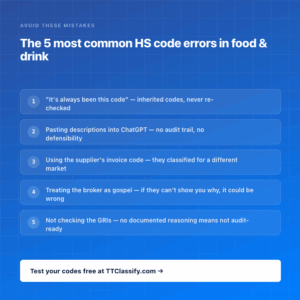
- “It's always been this code.” Codes inherited from launch, never re-checked. Tariff schedules change regularly. Products reformulate. The code that was right five years ago may not be right today.
- Pasting product descriptions into ChatGPT. A general-purpose model gives you a code. It does not give you the right code, and it does not give you a defensible audit trail. HMRC's own guidance acknowledges the limits of generative AI for compliance work.
- Using the supplier's invoice code. The supplier classified for their export, often into a different market under different rules. The liability for getting it right at UK import sits with the importer of record.
- Treating the broker as the oracle. If your broker can't show you why a product sits under a particular code, it could very likely be wrong. Don't take their word as gospel.
- Not checking the GRIs or Explanatory Notes. Applying the General Rules of Interpretation, and reviewing Explanatory Notes, means you've reviewed the rules and regulations in place to reach the correct code. The key is to document the reasoning afterwards so you are audit-ready.
Test your own food and drink tariff codes
The fastest way to find out whether the codes you ship under are correct is to test a handful. TTExplore is free to sign up and pay-as-you-go: describe a product and you get up to three grounded code suggestions with the reasoning and the WCO guidance behind them, and you make the call. Where the code needs to stand up to an audit, TTVerified adds expert review and a full audit trail, and includes a 14-day free trial of 10 classifications with no card required. Both are built on 15 years of customs classification data, a practical way for food and drink businesses to check tariff codes and assign codes to new SKUs.
FAQ

Elizabeth Davies
Elizabeth has more than 15 years’ experience in customs classification, advising UK retailers, manufacturers and food producers on getting commodity codes right and keeping them right. A regular speaker at Food and Drink Federation (FDF) webinars, she leads the team behind TariffTel’s expert-verified classification methodology.
Connect with Elizabeth on LinkedIn