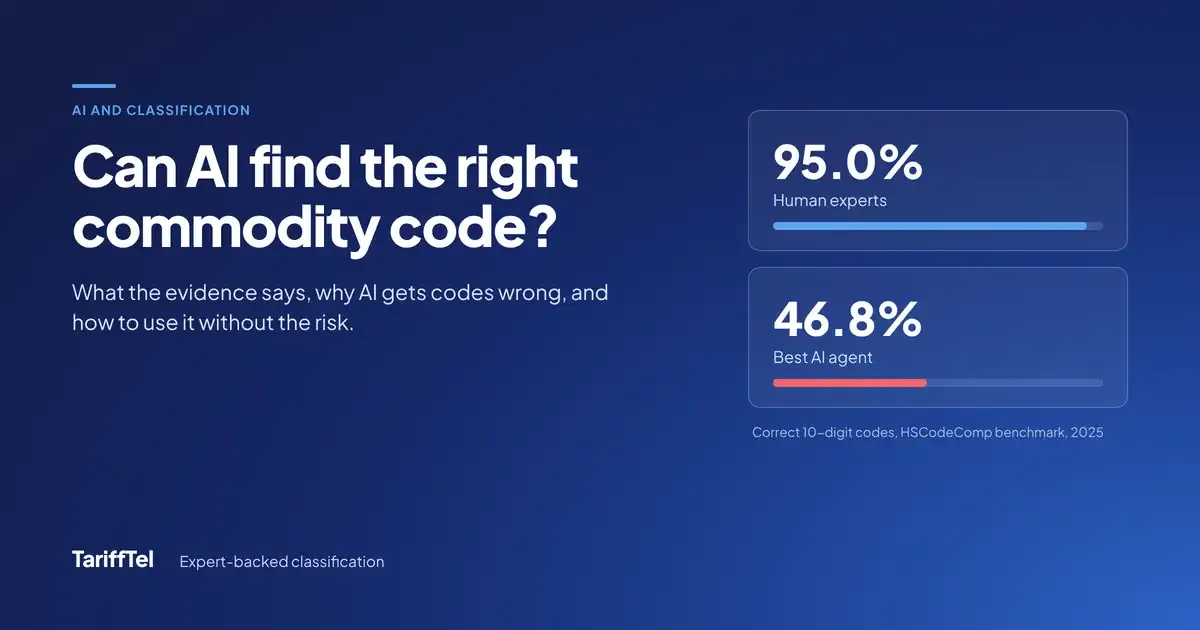
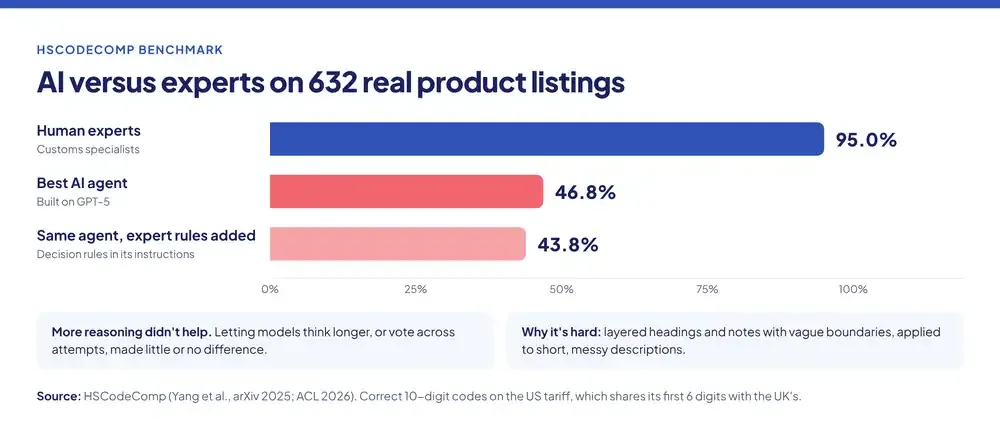
AI can shortlist commodity codes in seconds, and it's useful for research. It isn't reliable enough to declare on without a check. In a 2025 benchmark built from real product listings, the best AI agent chose the correct 10-digit code 46.8% of the time, against 95% for human experts. And whichever tool suggests the code, the importer is still liable for it.
Key takeaways
- In the HSCodeComp benchmark, the best AI agent scored 46.8% at 10 digits; human experts scored 95.0%
- In that study, giving the AI expert-written decision rules or more time to reason did not close the gap
- AI goes wrong when a description leaves out the detail that decides the code, such as material, composition or how a product is made
- The importer is responsible for the code on the declaration, whether it came from a person, a broker or a tool
- Use AI to shortlist and explain, then have a named person check the code against the tariff and record why
AI ran through the agenda at the ACITA Autumn National in London in October 2026, from HMRC's session on its approach to AI to the trade and software view from the Association of Freight Software Suppliers. The message from the day was consistent. AI is speeding up customs work, but a confident answer isn't the same as a correct one, and customs professionals stay responsible for the decision.
This guide looks at what the evidence says about AI and classification, why it goes wrong, and how to use it without taking on the risk.
What the research says about AI and commodity codes
The most rigorous public test so far is HSCodeComp, a benchmark published in October 2025 and presented at ACL 2026, the main academic conference for language AI. The researchers took 632 real product listings from large e-commerce platforms, with the short, messy descriptions sellers actually write. Customs experts assigned the correct 10-digit code to each one. The team then tested 23 AI models and agents against them.
| Who classified | 10-digit accuracy |
|---|---|
| Human experts | 95.0% |
| Best AI agent (built on GPT-5) | 46.8% |
Two findings matter as much as the headline. Adding expert-written decision rules to the AI's instructions didn't reliably help, and for some systems it made results worse. Letting the models spend longer reasoning didn't improve them either. The researchers put the gap down to how tariff rules work: a hierarchy of headings and notes with vague boundaries, where each decision depends on the one before.
The study used the US tariff, which shares its first six digits with the UK's. The last four digits differ, so these figures don't measure accuracy on UK codes. But the hard part, applying layered legal rules to an incomplete description, is the same in both. A figure from one study isn't a verdict on any particular tool. It's a reason to check.
Why AI gets commodity codes wrong
A language model predicts the most likely answer from the words it's given. Classification doesn't work like that. The code is decided by the General Interpretative Rules, the section and chapter notes and, very often, by one detail the description leaves out. When that detail is missing, AI tends to fill the gap with a plausible guess, and it rarely tells you it has guessed.
| Product | The detail that decides the code | What changes |
|---|---|---|
| Milk chocolate bar | Whether it has a filling, such as a caramel centre | 1806 31 (filled) or 1806 32 (not filled) |
| 350ml mug | Whether the body is stoneware or porcelain | 4% or 12% duty, with anti-dumping duty from China either way |
| Women's T-shirt | Lace decoration | Moves from 6109 (T-shirts) to 6106 (blouses and shirts) |
| Slim card holder | A steel outer surface | Moves from 4202 (cases) to 7326 (articles of steel), in UK CBAM scope |
| Bamboo utensil set | The material of the working edge, not the handle | Decides the heading |
These come from TariffTel's worked examples. In each case, a supplier description such as "MUG 350ML ASST DESIGNS" gives an AI, or a person, nothing to decide with. Our guide on how to provide a clear goods description covers what to capture.
There are three other common causes.
The tariff changes. Codes are added, split and closed, and rates move. A model trained on older material may not know.
The last four digits are national. A model that has mostly seen US or EU data can land on a code that doesn't exist in the UK Trade Tariff.
Confidence isn't evidence. A fluent answer with a code and a reason looks finished. It may not have applied the chapter notes at all.
Where AI does help
None of this means AI has no place in classification. Used well, it takes a lot of manual work away. The uses discussed at ACITA included:
- reading invoices and shipping documents and pulling out the data a declaration needs
- spotting inconsistent data, such as a description that doesn't fit the code or the weight
- narrowing thousands of headings to a short list of likely codes, with the reasoning shown
- flagging possible compliance issues for a person to look at
- cutting repetitive admin
The common thread is that AI does the legwork and a professional makes the call. The useful tools leave a clear route for that review, rather than presenting an answer as final.
Who is responsible if an AI tool gets the code wrong?
You are. In the UK, the importer is liable for the duty on its declarations, including when a broker declares for it under direct representation. HMRC's penalty guidance, Customs Notice 301, says that relying on another person to do the task isn't a reasonable excuse, and neither are genuine mistakes or acting in good faith. Nothing in that guidance treats a suggestion from software any differently.
The consequences are the same as for any wrong code. HMRC can recover underpaid duty and import VAT, normally for up to three years, with interest, and can charge a civil penalty of up to £2,500 per error. We set out the detail in what happens if you use the wrong commodity code.
The US has gone further. In January 2026, US Customs and Border Protection ruled in HQ H350722 that an AI tool isn't a "person" under its customs broker rules, and that where AI classification is used for goods being entered, the final classification decision must be made by a licensed customs broker. That ruling doesn't apply in the UK, but it shows where regulators are heading: AI can inform the decision, and a person makes it.
How to use AI for classification without the risk
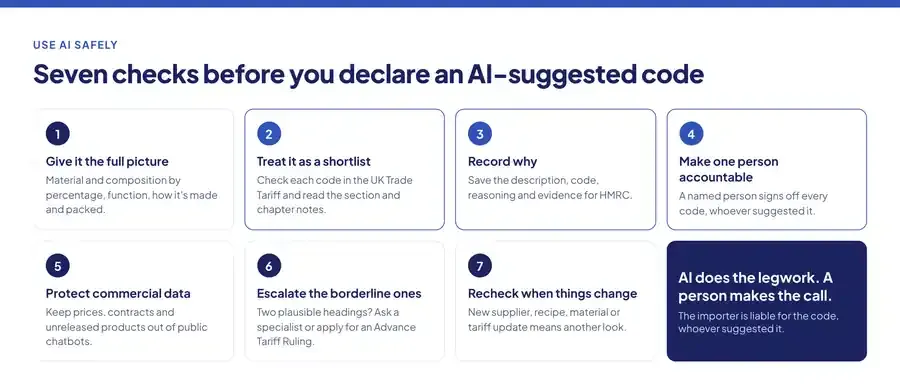
Give it the full picture. Material and composition by percentage, what the product does, how it's made and how it's packed. The deciding detail is usually in the specification, not the product name.
Treat the answer as a shortlist. Check each suggested code in the UK Trade Tariff, read the section and chapter notes, and look for rulings on similar goods. Our guide on how to check a UK commodity code walks through it.
Record why. Save the description, the code, the reasoning and the evidence. If HMRC asks in three years' time, that record is your answer.
Make one person accountable. Someone in your business should sign off each code, even if a tool or a broker suggested it.
Protect commercial data. Don't paste supplier prices, contracts or unreleased product details into a public chatbot, and check how any tool stores what you enter.
Escalate the borderline ones. If two headings both look plausible, ask a classification specialist or apply for an Advance Tariff Ruling.
Recheck when things change. A new supplier, recipe, material or tariff update means the code needs another look.
How TariffTel uses AI
We use AI in both of our platforms, in different ways.
TTExplore is our AI classification tool. Describe a product in plain English and it returns up to three ranked UK codes, each with a confidence score and the reasoning from section down to commodity code. If an important detail is missing, it asks the question that settles it. You review the workings and choose the code. Credits start from £2 a code.
TTVerified works the other way round. Codes come from around 180,000 expert-built item types that ask the questions the tariff doesn't, such as whether a chocolate bar is filled. AI tidies up poor supplier descriptions and points out what's missing. A customs specialist verifies every code, and the reasoning is logged for your audit trail alongside duty rates and anti-dumping, CBAM and EUDR flags. The 14-day free trial includes 10 classifications, no card needed.
Either way, the AI shows its working and a person makes the decision. That's the standard any classification tool should meet.
FAQ

Elizabeth Davies
Elizabeth has more than 15 years’ experience in customs classification, advising UK retailers, manufacturers and food producers on getting commodity codes right and keeping them right. A regular speaker at Food and Drink Federation (FDF) webinars, she leads the team behind TariffTel’s expert-verified classification methodology.
Connect with Elizabeth on LinkedIn