The importer pays, not the broker.
Key takeaways
- HS codes are the global language of customs: the first six digits are identical in 200+ countries, while the final digits (10 in the UK) determine your actual duty, VAT and import measures.
- For food and drink, classification turns on composition by weight, processing state, sweetening, threshold values (cocoa, sugar, milk fat, juice) and packaging — not just what the product is called.
US Customs has around $3.5bn of new AI and enforcement funding, and won a record $54.4m settlement back in December 2025, which is a lesson for anyone who trades not just with the US, but across any border: incorrect tariff codes are your liability alone, not anyone else’s.
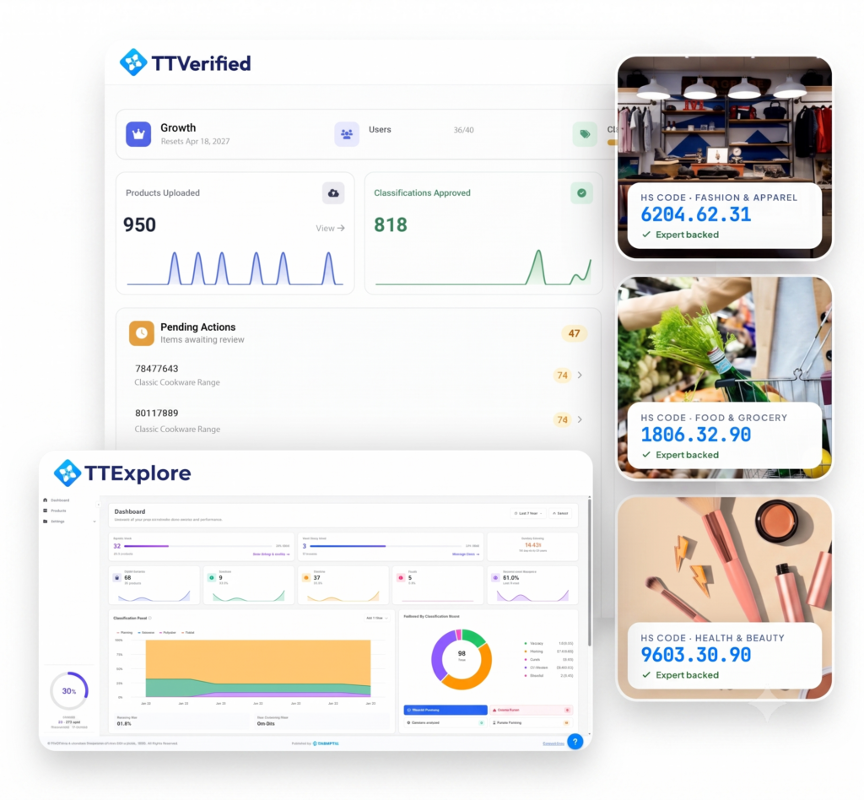
If you ship to the US and leave classification to your broker, US Customs will still see the importer of record, the company with legal liability for every code on every entry, as the importer. Customs and Border Protection (CBP) has just been handed billions of dollars to find any tariff codes that are wrong. It makes the case for using a classification platform, like TTVerified, that ensures you have the correct code, with the audit-trail to back it up, even more compelling.
In June 2026, roughly $3.5bn was directed to CBP for technology, artificial intelligence and enforcement, and the agency has partnered with a private AI screening provider to flag anomalies in classification, valuation and origin before cargo lands. It is already paying off. CBP recovered around $35bn through entry-summary reviews in fiscal 2025, up from $667.6m the year before. And it is not only the obvious offenders getting caught: importers in good standing are receiving surprise duty adjustments and having shipments flagged more often.
December 2025 set the benchmark. Ceratizit USA agreed to pay $54.4m over evaded duties on Chinese tungsten carbide, the largest customs settlement in the history of the False Claims Act. In this case, goods were misclassified under the Harmonized Tariff Schedule to cut the duty rate to zero, the origin was disguised by routing through Taiwan to dodge Section 301 duties, marking duties left unpaid.
The liability does not move
Strip away the US specifics and this is not just a lesson for America, but relevant to everyone. The importer of record is legally responsible for the accuracy of the declaration. “That was the broker’s job” is not a defence any authority accepts, HMRC included, and a new US executive order now requires brokers to vet the importers they act for. Once an authority finds one wrong code, it rarely stops at one shipment, it typically reopens every past entry of that product.
Classification can often be a judgement call, not a simple lookup, and the judgements that catch people out can be small. The same product in the US could have a completely different tariff code in the UK. For example a metal eyelash curler in the UK is classified under Heading 8203 (ATR 600013178) where as in the US its classified under Heading 9615 (NY N231572). Both are single tariff sets of products classified as the eyelash curlers providing the essential character. Get it wrong once and the same code is copied onto the next order, and the next, until a review turns twelve months of entries into a back-duty letter on one SKU.
Proof, not just a code
There is a timely reason to act now. With the IEEPA tariffs struck down in February 2026, many importers are receiving refunds on duties they should not have paid. Spending some of that money on classification that stands up to scrutiny is a better use of funds than waiting for the review that tests whether your codes were ever right.
None of this is about paying more duty than you owe. It is about being able to prove the duty you owe is correct, with the reasoning, and the audit-trail it was right on the day you filed. That is what audit-ready means, and it’s why many are turning to our TTVerified solution to be sure of every code they ship.
Get in touch with our team to find out more.

Elizabeth Davies
Elizabeth has more than 15 years’ experience in customs classification, advising UK retailers, manufacturers and food producers on getting commodity codes right and keeping them right. A regular speaker at Food and Drink Federation (FDF) webinars, she leads the team behind TariffTel’s expert-verified classification methodology.
Connect with Elizabeth on LinkedIn