How does preparation and packaging impact food and drink tariff codes?
 4 mins
Topics
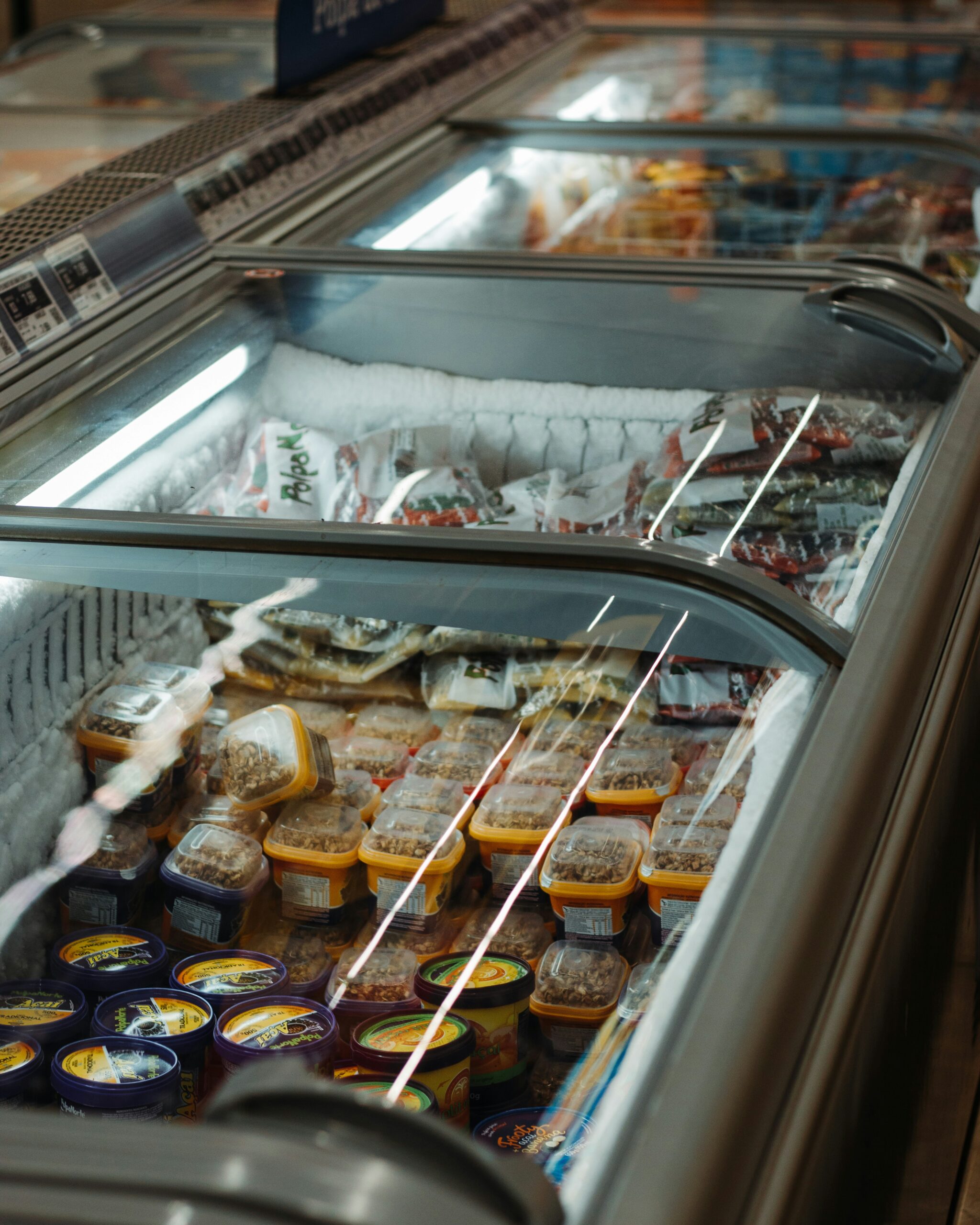
Tariff classification for food and drink products is rarely simple. Exporters dealing with composite goods, processed ingredients, or variable packaging formats face a unique challenge. Even small differences in how a product is prepared or presented can significantly impact its tariff code and the amount of duty to pay.
For example, whether a product is baked or fried, frozen or chilled, packaged for retail sale or bulk distribution, can all determine which tariff code applies. A single misclassification can be replicated across thousands of SKUs, meaning financial and operational risk. Getting classification right every time matters. The devil is in the detail.
Understanding the classification criteria specific to food and drink is essential if you’re to classify products correctly and compliantly.
Why food and drink products require special attention
 Food and drink items are among the most technically complex to classify. Unlike other retail products, their classification often depends on factors that go beyond a basic description:
–How is the product preserved? Frozen, dried, vacuum-sealed, or pickled goods can fall under different tariff headings.
–What ingredients are included? Composite goods, like ready meals or snack packs, may contain multiple components that influence classification.
–Is the packaging for retail or bulk? This distinction alone can shift the duty rate or affect preferential treatment under trade agreements.
The compliance risks of misclassification
Customs authorities in the UK, EU, and US are intensifying audits and requiring more detailed documentation. For food and drink businesses, misclassification carries high stakes:
–Overpaid duties that erode profit margins
–Incorrect use of preference schemes, risking retroactive penalties
–Shipment delays or rejections at the border, especially for perishable goods
–Loss of trusted trader status, such as AEO
All of these outcomes can be triggered by a single misclassified product or an incomplete audit trail. Audit‑ready classification means having a clear, documented trail that links product characteristics, such as ingredients, nutritional content, processing methods, and packaging, to the final tariff decision. Systems like our TariffTel platform store and track documentation and imagery supporting reporting and compliance requirements when needed.
What to look for in a classification system that manages food and drink classification
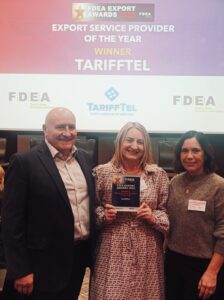 TariffTel is an FDEA award-winning classification system that ensures that all relevant food and drink attributes are captured automatically and accurately to provide the correct tariff code. Backed by classification experts and trusted by leading businesses like M&S Food, TariffTel makes classifying complex food and drink items simpler.
For food and drink goods specifically, the system is built to ensure it captures the following:
–Nutritional content, such as sugar and fat percentages
–Processing methods, like baking, steaming, or fermenting
–Supplier-sourced specifications, integrated directly into classification workflows
And when there are edge-case items, these go for expert review to our team of specialists who use the latest guidance including General Rules of Interpretation (GRIs) and binding rulings to determine the right code.
Crucially, every classification decision is documented and audit-ready.
Case Study: How M&S Food overcame classification complexity
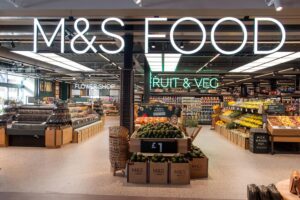 When Brexit brought a raft of new regulations and customs procedures, the food and drink industry faced one of its greatest challenges. Food and drinks goods are notoriously hard to classify due to their complex make‑up, extensive ingredients lists, varying production methods, and different packaging formats—all factors that can shift a product’s tariff classification.
M&S Food met this challenge head‑on by implementing TariffTel to manage all food classification. TariffTel provided the streamlined, accurate, and fast approach to classification that was needed at this time, ensuring that M&S’s much‑loved products continued to cross borders smoothly through Brexit without disruption to customers.
A key part of M&S’s response was also its engagement in an Authorised Economic Operator (AEO) application, which requires businesses to prove that their systems are robust and fully compliant with customs regulations. TariffTel formed a part of this successful application by delivering audit‑ready classification processes that underpin effective customs governance.
TariffTel integrates with internal M&S systems and leverages supplier data to capture all necessary product characteristics, including detailed information such as sugar and fat content. This ensures the correct tariff code is assigned,even for highly complex products, such as vegan composite ready meals with multiple ingredients.
The results speak to both compliance and operational efficiency:
-100% compliance record across classified food and drink products
-90% accuracy in product master data
-A five‑fold improvement in classification turnaround times
-Elimination of shipment delays caused by incorrect tariff codes
This digital transformation not only protected M&S from customs errors and duty miscalculations but also provided a framework for future classification, enabling seamless trade with suppliers and stores across Northern Ireland and beyond.
Classification gives a strategic advantage
For UK food and drink exporters, tariff classification is the cornerstone to compliance. In a sector where margins are tight and regulatory complexity is growing, approaching classification strategically with a system like TariffTel, supports growth in a business, enhances reputation, and ensures smooth running supply chains.
Read more about recent changes to tariff codes relating to food and drink
Other Useful Resources
Blog
3 mins
Meet TariffTel at IFE Manufacturing 2026
Visit our stand at IFE Manufacturing, ExCeL London | 30 March – 1 April | Stand N678 We’re exhibiting at ...
Blog
2 mins
TariffTel is now ISO 27001 certified
Your product data, protected to the highest standard. We’ve achieved ISO/IEC 27001:2022 certification, the internat...
Blog
4 mins
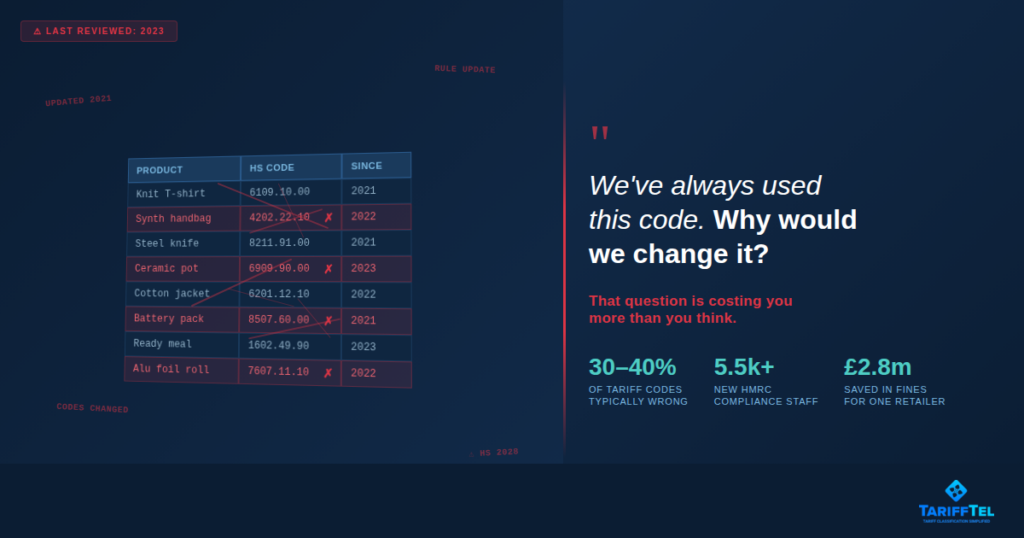
“We’ve always used this code. Why would we change it?”
That question is costing you more than you think. It sounds reasonable. The code worked last time. Your broke...


