Classifying Christmas products in 2026: what the new harmonised rules mean for your tariff codes
 5 mins
What this Christmas tariff code guide covers:
• The 2025 rule change that simplified Christmas classification for 2026
• What heading 9505 is, and what now counts as a “Christmas article”
• Two worked examples: a robin in a Santa outfit, and a figurine holding a candy cane
• Where the line still sits: what is NOT automatically a Christmas article
• Whether the UK and EU positions match
• Why wooden festive products face a second hurdle: EUDR
What changed for Christmas classification in 2026?
The biggest change is that the UK and EU have brought their tariffs into line with the WCO Harmonised System, removing a Chapter Note that had caused years of confusion over festive goods. On 1 November 2025 the EU removed Additional Note 1 to Chapter 95 through Commission Implementing Regulation (EU) 2025/1926, published in the Official Journal on 31 October 2025. The UK Trade Tariff follows the same position for 2026.
That note was used to define, and limit, what counted as an “article for Christmas festivities.” With it gone, the WCO Explanatory Notes now apply directly. For importers, this means a clearer, more consistent approach to classifying Christmas ranges, and in many cases access to the lower duty rates under heading 9505 that were previously out of reach.
What is heading 9505 and what counts as a “Christmas article”?
Heading 9505 covers festive, carnival and other entertainment articles, and subheading 9505 10 covers articles for Christmas festivities specifically. Christmas articles typically attract a low duty rate, so whether a product lands here or in an alternative heading, it has a direct effect on landed cost.
In June 2025 the WCO revised the Explanatory Notes for 9505 to widen the definition of “articles of Christmas.” The revised text brings in figurines and hanging decorations that carry Christmas symbols and are mainly used at Christmas, even if they are not designed to hang on a tree, such as:
• decorative figurines holding candy canes
• decorative figurines with clothing or accessories in the colours, design or shape of Father Christmas
Until late 2025 the UK and EU Chapter Notes did not reflect this, which is what created the confusion. That gap has now closed.
Why were Christmas codes so confusing before 2026?
Until 1 November 2025, the legally binding Chapter Notes and the WCO interpretation pointed in different directions. The old Additional Chapter Note said 9505 only covered items with a long-standing Christmas tradition, and specifically excluded general winter items such as robins, reindeer and snowmen, even when they looked festive. The WCO notes took a broader view. The same product could therefore arrive at two defensible codes with two different duty rates. We covered that period in detail in our earlier article on conflicting tariff notes. With the Chapter Note removed, that conflict no longer exists.
Worked example: how is a robin in a Santa outfit classified now?
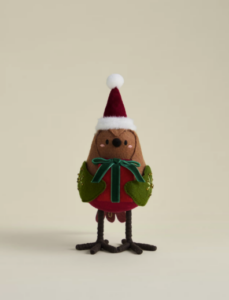 A decorative robin wearing a Father Christmas jacket and hat is now classified as a Christmas article under heading 9505, rather than by its material. Before the change, the binding Chapter Note treated it as a general winter decoration, so it was classified by what it was made from: a textile robin fell into Chapter 63, and a plastic one into heading 3926, at a higher duty rate. Under the harmonised approach, the Father Christmas styling makes it a Christmas article.
Worked example: what about a figurine holding a candy cane?
 A decorative figurine holding a candy cane is now treated as a Christmas article under 9505, in line with the revised WCO notes. The candy cane is one of the specific examples the WCO added when it widened the definition. Previously a figurine like this could have been pushed out of 9505 and classified on material, at a higher rate. Now the Christmas symbol it carries is enough to keep it in the festive heading.
Does this mean everything festive is now a Christmas article?
No. The change removes a conflict, it does not make everything Christmas. Two limits still matter:
• Costumes are still garments. A textile Father Christmas jacket and trouser set is excluded from 9505 by the Chapter 95 exclusion for textile fancy dress, and is classified as garments under Chapter 61 or 62. That exclusion is unchanged.
• Pure winter items are still classified by material. A plain reindeer in a snowy scene, with no Christmas symbols, is a winter decoration, not a Christmas article.
We are also watching the rulings that follow this change closely, to see how far customs authorities take the broader interpretation in practice. The direction is clearer, but the detail still rewards careful classification.
Is the UK position the same as the EU?
 Yes, for 2026 the UK Trade Tariff aligns with the EU on this point. The EU made the change through its 2026 Combined Nomenclature, and the UK applies the same removal of the Chapter 95 Additional Note. Importers moving goods into both markets can take a consistent approach to festive ranges, though duty rates themselves still differ by territory, so always check the rate for the market you are importing into.
What about wooden Christmas products and EUDR?
Getting the tariff code right is only half the job for wooden festive goods: the EU Deforestation Regulation (EUDR) is a separate hurdle. EUDR covers wood and wood-derived products, which includes many wooden Christmas decorations and ornaments. It requires due diligence and geolocation data on where the wood was produced, and products that cannot meet it may not be placed on the EU market. This impacts imports into the EU, including Northern Ireland. For the UK, the UK Forest Risk Commodity (FRC) regulation is the equivalent when that comes in.
Following a targeted revision agreed in December 2025, EUDR now applies from 30 December 2026 for large and medium operators, and from 30 June 2027 for micro and small operators. For Christmas ranges, that means wooden festive lines need both a correct classification and EUDR-ready supplier data well ahead of those dates.
How to get Christmas classification right for 2026
1. Start now. Christmas ranges are classified months ahead of the season, so build the work into your current planning, not October.
2. Re-check anything you parked in 2025. Lines held back during the uncertainty may now qualify as Christmas articles at a lower duty rate.
3. Look for the Christmas symbol. Father Christmas colours and styling, candy canes and similar symbols can now bring an item into 9505, even if it is winter-themed.
4. Keep costumes separate. Textile fancy dress stays in Chapters 61 and 62, not 9505.
5. Capture material and construction data. For anything that is not clearly a Christmas article, the code still depends on what it is made from.
6. Flag wooden lines for EUDR. Classification and deforestation due diligence are two separate gates.
7. Document your reasoning. Record why each code was chosen so the duty position is defensible if questioned.
Key takeaways
• From 1 November 2025, the UK and EU align with the WCO on Christmas articles: the old conflicting Chapter Note is gone.
• Winter items with clear Christmas symbols, such as a robin in Father Christmas colours, can now sit in heading 9505.
• 9505 usually carries a lower duty rate, so reclassification can reduce landed cost.
• Textile costumes are still garments under Chapters 61 and 62, not Christmas articles.
• Wooden festive products face a second hurdle in EUDR, which applies from 30 December 2026 for larger operators.
• Classify early, re-check parked ranges, and keep your reasoning on file.
Frequently asked questions
What is the tariff code for Christmas decorations in the UK?
Most Christmas decorations that qualify as articles for Christmas festivities fall under heading 9505, subheading 9505 10. The exact 10-digit code and duty rate depend on the product and the market. Items that do not qualify are classified by their material.
Did the rules for classifying Christmas products change in 2026?
Yes. On 1 November 2025 the EU removed Additional Note 1 to Chapter 95 to align with the WCO, and the UK Trade Tariff follows the same position for 2026. This resolved a previous conflict between binding notes and WCO guidance.
Is a Christmas jumper a Christmas article?
No. A knitted Christmas jumper is a garment, classified under heading 6110, not as a Christmas article under 9505.
Is a Father Christmas costume a festive article?
Generally no. A textile Father Christmas costume is excluded from 9505 as fancy dress and is classified as garments under Chapter 61 or 62. A non-textile novelty item, such as an inflatable costume, can fall under 9505.
Does the change mean lower duty on Christmas goods?
In many cases, yes. Heading 9505 usually attracts a lower duty rate than the alternative material-based headings, so items that now qualify may benefit from a lower rate. Always confirm the rate for your specific code and market.
What happens if I get a Christmas code wrong?
An incorrect code can mean overpaid or underpaid duty, delays at the border, and exposure to penalties. With Christmas ranges, where volumes are high and timing is tight, an error multiplies quickly across a range.
Classify your Christmas range with confidence
TariffTel’s tariff code solutions keeps pace with changes like the 2025 Chapter 95 update so your festive ranges are classified accurately, quickly and consistently across markets. Our expert-led platform takes the research burden off your team and keeps your codes current.
Read more about getting tariff codes right for Christmas products.
Get in touch to get Christmas-ready for 2026.