“We’ve always used this code. Why would we change it?”
 4 mins
Topics
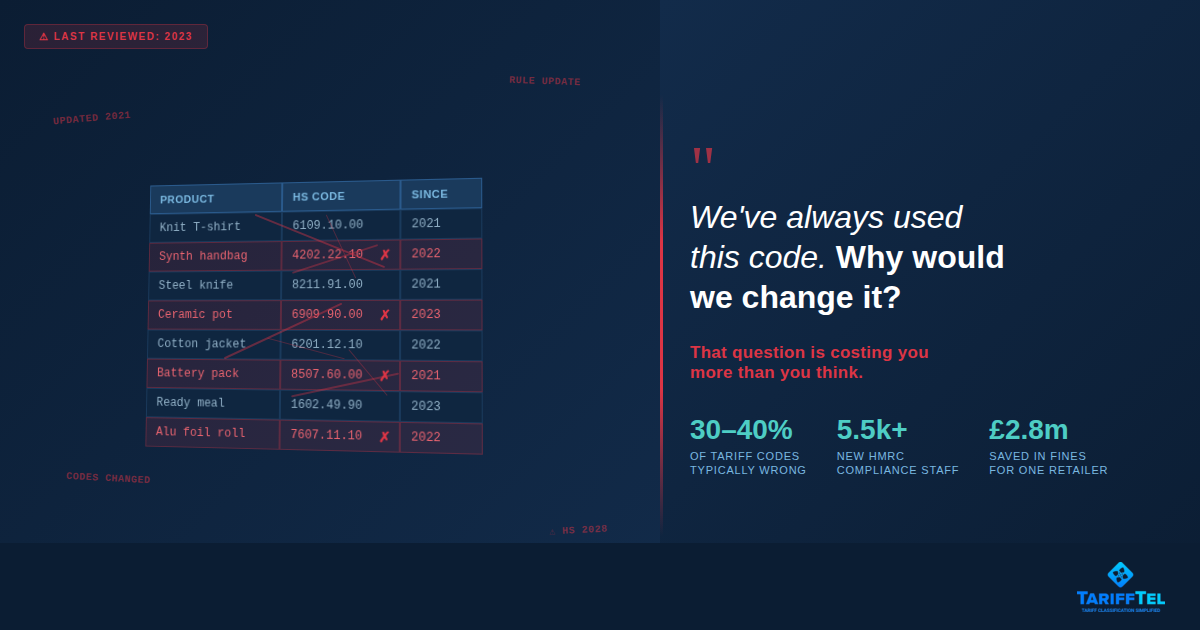
That question is costing you more than you think.
It sounds reasonable. The code worked last time. Your broker didn’t flag it. HMRC haven’t been in touch. Nobody’s been fined. So why would you touch something that isn’t broken?
Here’s what usually happens in this common scenario.
You classified a product three years ago. Maybe your broker did it. Maybe someone on your team looked it up, found a code that seemed right, and logged it in a spreadsheet. It cleared customs. Duties were paid. Goods arrived. Job done.
Since then, you’ve used the same code again. And the next. It became the default. It’s been copy and pasted into purchase orders, embedded into your ERP, referenced by your finance team for landed cost calculations. Nobody questioned it because nobody had a reason to.
Now multiply that across your entire product range.
Hundreds of codes. Maybe thousands. Each one assigned at a point in time, based on the information available at that moment, and never revisited.
This is how most businesses operate. And it’s how most businesses end up with 30–40% of their tariff codes wrong without knowing it. We see it every day.
The false premise: a code that was right once stays right forever.
Tariff codes are not fixed. The World Customs Organisation updates the Harmonised System every five years. Between those cycles, HMRC issues binding classification guidance that can impact entire product categories. Trade agreements shift preferential rates. Anti-dumping duties appear and disappear. New incoming regulations like CBAM or EUDR introduce requirements that didn’t exist when your original code was assigned.
One retailer we work with used the same HS codes for years and after a review found that 45% of the codes they were using with wrong. This could potentially could have cost them as much as £2.8 million in fines if this misclassification had been detected by customs authorities. They now have weeks of work ahead of them as they correct their codes across all systems. All of this is avoidable if they’d had a classification system in place that notified them of updates in real-time and automated changes directly.
This scenario is commonplace. In 2028, the next major Harmonised System major update lands with an expected 299 sets of amendments, 1229 headings and 5852 subheadings which will most likely impact almost all UK businesses shipping internationally affecting industries such as electronics, pharmaceutical and green technology to name a few. Every business that imports goods will need to review and potentially reclassify significant portions of their product range and whilst it might seem a long time away, the time to get ready is now. Working on spreadsheets and reclassifying this volume of products manually could take months.
When the 2026 tariff book updates came into force on 1st January, TariffTel customers had all necessary changes implemented by 2nd January. Every affected code identified, reviewed and updated within 24 hours. One retailer we spoke to was still making changes months after the update. That’s months of incorrect tariff codes and potential overpayments, compliance exposure and audit risk, without even realising it.
The real cost of misclassification
When you don’t actively maintain your tariff codes, several things happen. You pay the price of getting it wrong.
You overpay duties. Across a large product range over several years, this compounds into serious amounts. One UK retailer working with Barbourne Brooks, discovered over £1 million in overpaid duties across three years traced back to 336 misclassified SKUs across 58,000 customs declarations.
You lose preferential treatment. A product sourced from Vietnam might qualify for 0% duty under the UK-Vietnam FTA. But if the code is wrong, the preference doesn’t apply. You pay 12% instead. That equates to margin, gone.
You create audit exposure. HMRC has added 5,500 new compliance staff. Audits are increasing. When they arrive, they’re retrospective often covering three years of declarations. Every code needs to be justified with clear reasoning and documentation. “We’ve always used this code” is not a defence.
You risk goods being destroyed through demurrage. When misclassification triggers your goods to be held at customs, there’s a clock ticking. For perishable goods, it’s days. For everything else, it can be as little as three weeks before goods are forfeited and destroyed. The stock is gone. The cost is sunk.
The question isn’t whether your codes have changed. They most likely have.
Tariff codes change constantly. Not just every five years, throughout the year.
The real question is whether you’d know if your codes were wrong. Most businesses wouldn’t. Not until the audit letter arrives, the shipment is held, or the finance team spots a margin they can’t explain.
What “always current” actually looks like
TariffTel tracks tariff changes as and when they happen, immediately alerting you to which of your products are affected. No manual checking is needed on your part. Every code is expert-verified and comes with documented reasoning and a full audit trail. When HMRC asks why that code, you have the answer ready.
The 2028 update is coming. Are you ready?
Businesses with automated, expert-backed classification systems will adapt within hours. Businesses running on legacy codes in spreadsheets will be scrambling for months. They risk non-compliance and potentially overpaying from day one.
Think your codes are still right? Let us test them.
Talk to our team about how TariffTel keeps your codes current, compliant and audit-ready.
Other Useful Resources
Blog
3 mins
Meet TariffTel at IFE Manufacturing 2026
Visit our stand at IFE Manufacturing, ExCeL London | 30 March – 1 April | Stand N670 We’re exhibiting at ...
Blog
2 mins
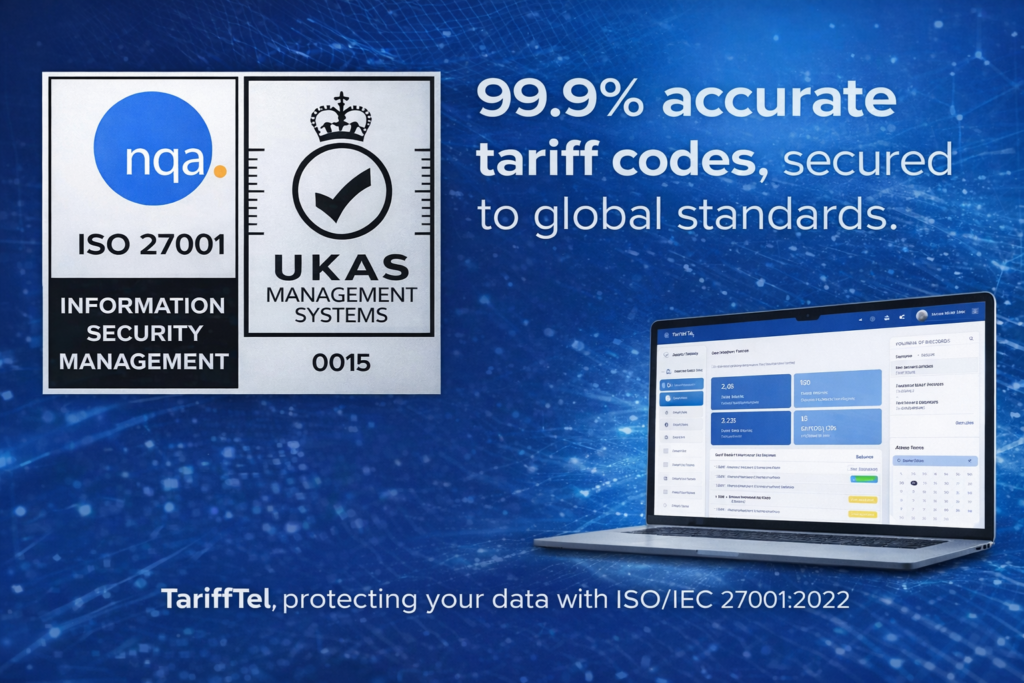
TariffTel is now ISO 27001 certified
Your product data, protected to the highest standard. We’ve achieved ISO/IEC 27001:2022 certification, the internat...
Blog
5 mins
Why 2 out of every 5 tariff codes are typically wrong
And what it’s costing you... Tariff codes might look like a routine administrative step when you’re preparing goo...


