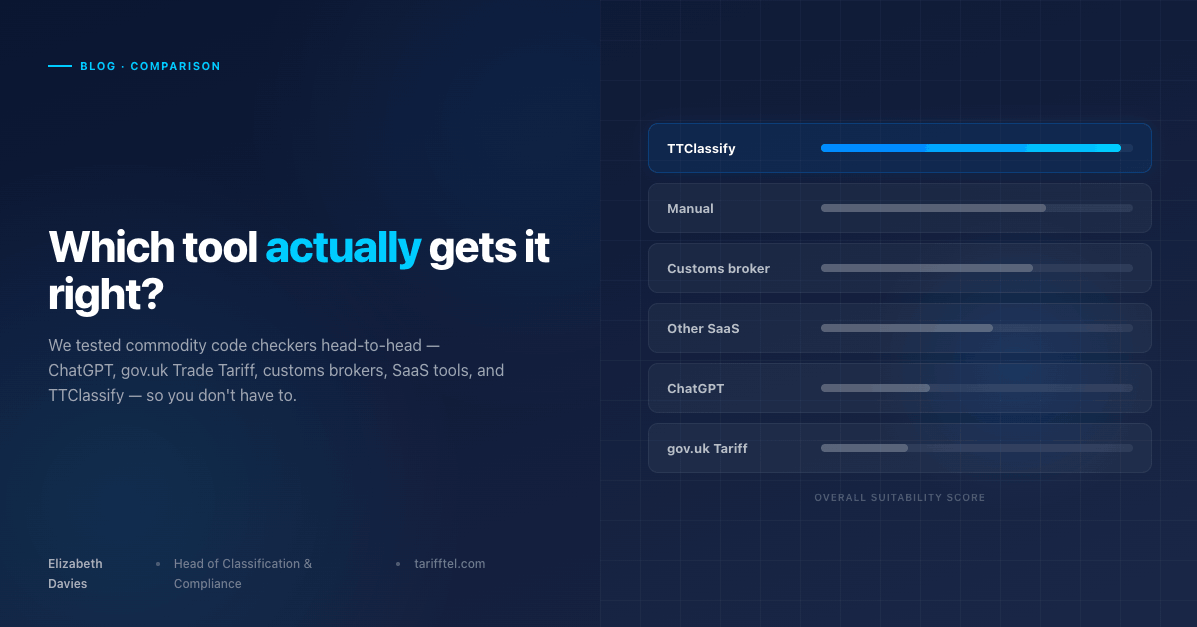
Commodity code checker: which tool actually gets it right?
 5 min
5 min
Commodity code checker: which tool actually gets it right?
By Elizabeth Davies · Head of Customs Classification & Compliance, TariffTel · May 2026
Search “commodity code checker” and you will get pages of options. Free tariff code lookups, AI classification tools, brokers, a long list of classification tools. They all promise the same thing, a quick way to find the right code. The trouble is, most of them will not.
After auditing over 1.5 million products across 15 years at TariffTel, our consistent finding is that two in five tariff codes are typically wrong.
The tool you choose is the difference between codes that hold up under scrutiny and codes that mean you’re either overpaying duty rates, or risking fines or shipment delays. What are the options for UK importers and exporters? Here, we outline what each tool actually does, and what you should look for when choosing a HS code checker for classification.
What is a commodity code checker?
A commodity code checker is a tool that helps you find the tariff code that applies to a product you import or export. In UK customs language, the commodity code is the 10-digit identifier the UK Trade Tariff uses to determine the duty rate, VAT and any controls, licences or preferences that apply to your goods.
Commodity code, tariff code and HS code refer to different levels of the same hierarchy. The first six digits are the international HS code, set by the World Customs Organisation. The EU extends it to eight digits (the Combined Nomenclature, or CN code). The UK extends it to ten digits or imports, and uses the first eight digits for exports. When UK businesses search for a commodity code checker, a commodity code lookup or the best HS code tool, they almost always mean the import code, although exporters also need to classify their goods to eight digits.
Is a commodity code checker the same as a commodity code lookup?
This is the most important distinction, and the one most people miss when choosing a tool.
A lookup is a search interface over the published tariff schedule. You type “ginger biscuits” and the tool returns the half-dozen codes that could plausibly apply. Then it asks you to pick.
A checker, makes the decision on the right code. It applies the General Rules of Interpretation, weighs the chapter notes, considers the composition and form of your product, and gives you one code, with reasoning and an audit trail.
The free government tool at gov.uk/trade-tariff is a lookup. A genuine checker is harder to find, and worth the effort.
Why does the commodity code checker you choose actually matter?
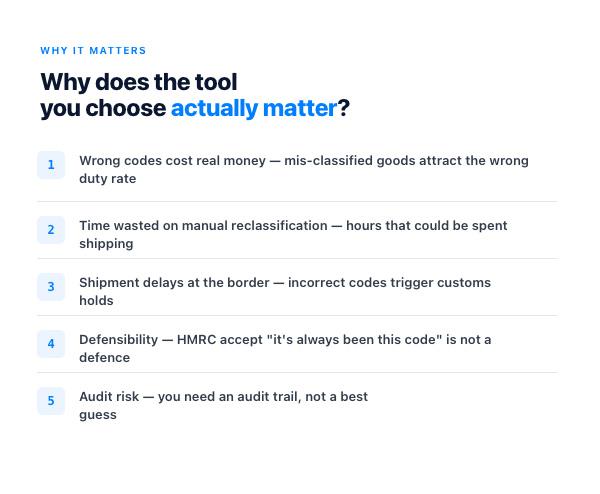
- Cost. The wrong commodity code under-declares duty for as long as the error runs. When HMRC find it, and they increasingly do, you owe the difference, three years back, The standard recovery window is three years, with interest and possible penalties. Where HMRC considers the error deliberate, that window extends to twenty years. A single SKU misclassified can quietly cost a small importer four or five figures. Bigger ranges produce bigger bills.
- Time. A held shipment costs hours of someone’s day, missed customer orders and detention charges at the port.
- Defensibility. HMRC do not accept “it’s always been this code” as a defence. They want to see your reasoning.
How do the main commodity code checker options compare?
The table below summarises how options perform against each other on the criteria that matters.
| TTVerified | ChatGPT & free tools | Manual classification | Customs broker | Other tariff code tools | |
|---|---|---|---|---|---|
| Accuracy | Expert-backed, every code | Unreliable. Confidently presented but often wrong | Variable. Depends on individual knowledge | Generally good. But no visibility into method | Often unverified or no claim given |
| Audit trail | Full audit trail. Reasoning & sources logged | None. No record of how the code was decided | Manual records. Only as good as your documentation | Limited. You rely on the broker | Partial. Rarely HMRC-ready |
| Speed | Seconds. Bulk upload available | Seconds. Fast but accuracy makes speed worthless | Hours to days. Research-intensive, doesn’t scale | Days to weeks. Dependent on broker turnaround | Minutes. Bulk varies |
| Cost | Free to start. £17 per code PAYG, or upgrade | Free. But wrong codes cost thousands in fines | Staff time. Hidden cost of hours per product | Varies by broker. Plus ongoing amendment fees | Varies. Often tied to annual contracts |
| Regulatory updates | Automatic. Real-time alerts for tariff changes | None. Training data is months out of date | Manual. You track changes yourself | Depends. Good brokers update, many don’t | Varies by provider |
| Scalability | Unlimited. Bulk classify thousands of products | One at a time. No bulk, no integration | Not scalable. More products = more hours | Slow to scale. More cost, more delays | Limited. Most cap volume or charge per code |
| Integrations & security | ERP, PLM, TMS & API. ISO 27001 certified | Not compliant. No audit trail, no regulatory awareness | Your risk. Compliance depends on your expertise | Liability for misclassification still sits with you | Gaps in coverage. Not declared. |
| Expert backing | 15 years. TariffTel customs experts back every code | None. No accountability | Internal only. Depends on individual training and qualifications | Lack of visibility means this is unknown | Varies. Many are tech-only |
Free tools: ChatGPT, gov.uk Trade Tariff, lookup sites
ChatGPT will produce a confident-sounding code for any description you paste in. It will not, in our testing experience, produce the right code reliably. The training data is months out of date, the model has no awareness of your destination market’s specific rules, and it provides no audit trail. The gov.uk Trade Tariff is free and authoritative as a database, but it is a lookup, not a decision engine. You still have to apply the classification rules yourself.
Use for: directional curiosity only. Never as the basis for a customs declaration.
Manual classification: your team and the tariff schedule
A trained classifier reading the tariff schedule and the General Rules of Interpretation can produce the right code. The problem is the time it takes, hours per product, and the difficulty of scaling that across SKU ranges that change every season. Most SMB importers have no-one in this role at all.
Use for: high-value products where a Binding Tariff Information (BTI) ruling is worth pursuing. Not viable for catalogue-scale classification.
Customs broker: the importer still retains responsibility, not your broker
Brokers move freight. Some are excellent at classification. Many use the code on the supplier’s invoice without re-checking it. The cost adds up quickly, and you rarely get visibility into how the code was decided.
Use for: complex, one-off shipments where you need someone to own the paperwork end to end. Not the right tool for catalogue classification you will have to defend in audit.
Other tariff code tools: SaaS solutions
A category of paid tools that sit between lookups and checkers. Quality varies enormously. Some apply genuine classification logic. Others don’t specify. Read the audit-trail and verification credentials carefully before signing.
Use for: where they demonstrably apply classification logic backed by subject-matter expertise. Worth pressure-testing on three or four of your products first.
TTVerified
Built on the TariffTel platform, the same classification engine ASDA, M&S, Primark and Portwest run on for enterprise compliance. The difference: TTVerified is a flexible, self-serve platform, designed for businesses that want to classify their own products without buying enterprise software and the flexible to move plans to suit business needs.
Every code is verified by TariffTel’s customs classification specialists. Every decision carries an audit trail with reasoning. Bulk upload and integration into ERP, PLM, broker and customs systems is available on higher tiers, and the platform is ISO 27001 certified for data security.
The first three classifications are free. Five minutes to sign up. After the free three, pay £17 per code or upgrade for bulk upload, integration and higher volumes.
Use for: any time you need a commodity code that has to hold up under HMRC scrutiny, and you would rather do it yourself than wait for a broker.
What makes a commodity code checker actually trustworthy?
Five things to look for when you compare. Use them as a checklist.
- Expert verification. Ask who verifies the code before it lands in your system and how the code is generated. Ask is they can share accuracy rates.
- Audit trail. Every code should come with reasoning. Without that, you cannot defend the decision to HMRC.
- Real customer evidence. Named businesses, not vague claims. TTClassify is built on the same engine used by ASDA, M&S, Primark and Portwest.
- Data security. ISO 27001 is the international standard for information security management. If you are uploading product information at any scale, certification is important.
- Regulation changes. Tariff schedules update annually, and updates happen all the time. If the tool does not tell you about changes, the codes it gives you could be out-of-date and you won’t know it.
Why TTVerified is the right tool for classification
TTClassify is built for businesses that want to:
- Test the commodity codes their products currently ship under, and find the ones that are wrong
- Classify new SKUs as ranges expand, reformulate or extend into new markets
- Replace expensive per-code broker fees with self-serve classification
- Move away from inherited codes that nobody has re-checked in years
- Build an audit-ready classification record without buying enterprise software
Key takeaways
- A commodity code checker is only as good as the human verification behind it
- Lookup tools, including ChatGPT and free databases, are not checkers. They hand back plausible codes and ask you to decide. You have no guarantee they are the right code
- A wrong commodity code can lead to a letter from HMRC, a held shipment and lost profit margin on a production run priced at the wrong duty rate
- Five things to look for: expert verification, audit trail, real customer evidence, data security, regulatory updates
- TTVerified gives you three free classifications, with expert-backed verification and a full audit trail behind every code
FAQ: commodity code checkers
Test your own commodity codes free
Three classifications free. Five minutes to sign up. The right code first time means the right duty rate, no HMRC surprises, and an audit trail you can defend.


